

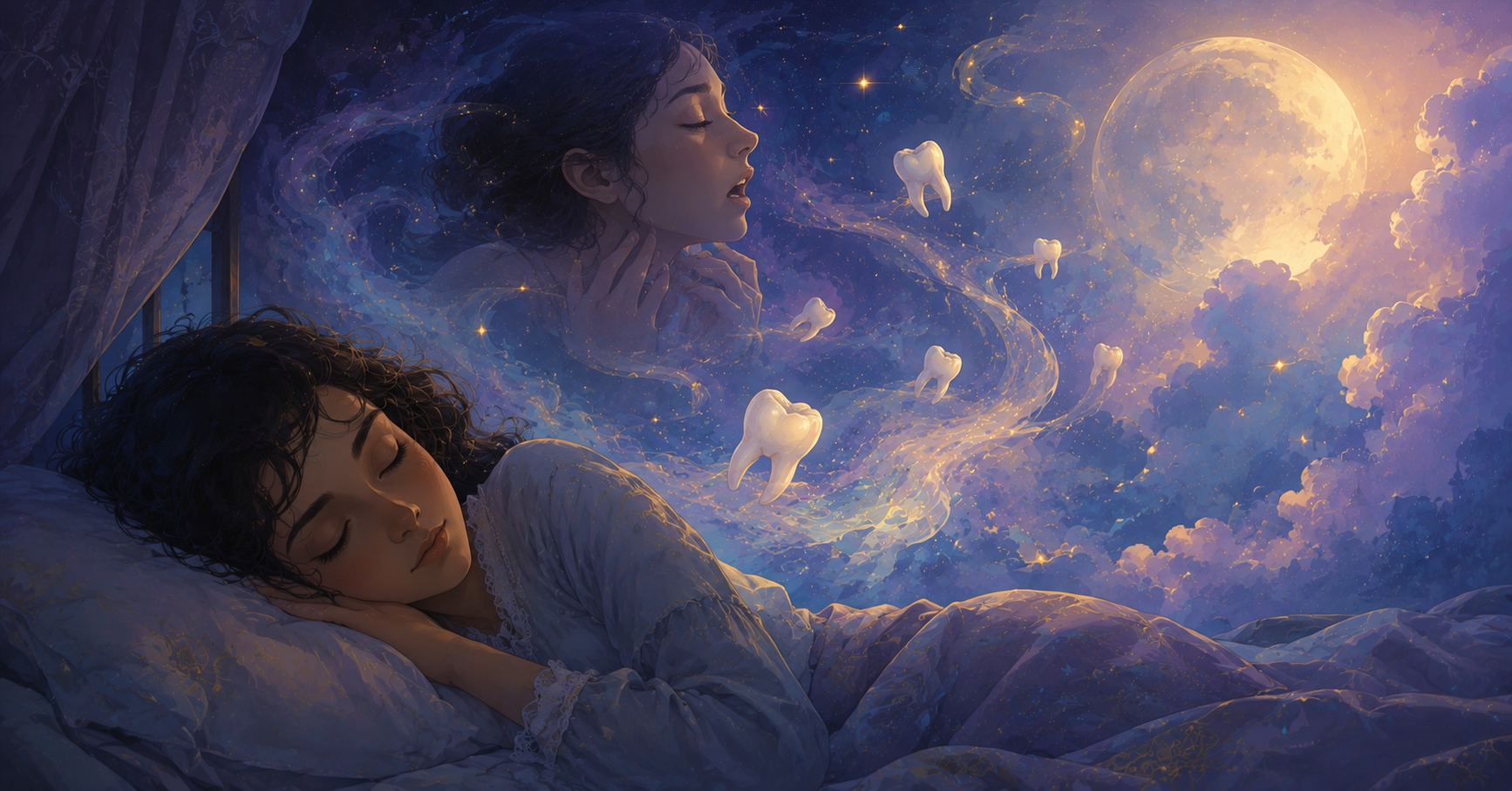
If you have ever jolted awake wondering what does it mean when you dream your teeth are falling out spiritual teachers, psychologists, and ancient traditions have all wrestled with this same haunting image for centuries — you are in extraordinarily good company.
The first instinct is always physical: your tongue moves immediately, checking, confirming, exhaling. The teeth are there. But the dread lingers in a way that an ordinary nightmare simply does not.
That lingering quality is worth paying attention to. This particular dream does not fade with your morning coffee the way most sleep experiences do.
It follows you, sits with you, and quietly insists on being taken seriously. There is a reason it ranks among the most universally reported dreams across cultures, age groups, and lived experiences — and that reason runs deeper than textbook anxiety.
What makes this dream so compelling is precisely the tension it holds between two worlds. On one level, sleep researchers have documented its strong connection to stress, performance pressure, and grief — very real, very human experiences that deserve acknowledgment.
On another level, spiritual traditions spanning millennia have read the same imagery as a communication from somewhere beyond the ordinary mind: a signal of transformation, release, or imminent awakening arriving in the only language the soul sometimes speaks fluently.
In my experience, this dream is more stressful, and I could wake up very down because the dream ends without new teeth. Also, I was taught that this was bad luck.
This article moves through both of those worlds without forcing you to choose between them. From biblical scripture to Indigenous wisdom, from Jungian psychology to contemplative practice, each section peels back another layer of what this powerful dream may genuinely be asking of you — and what you might do with the answer.
The Spiritual Meaning Hidden Inside the Fall
In nearly every major spiritual tradition, the body is never just the body. Each physical feature carries symbolic weight, and teeth sit near the top of that hierarchy.
They are rooted — literally anchored into bone — which makes them powerful metaphors for how firmly you are planted in your sense of self, your relationships, and your purpose.
Shamanic traditions across South America and Africa have long associated teeth with personal power and the ability to “hold on” to what matters.
In Hinduism, strong teeth in a dream can signify worldly strength, while their loss signals a shift in life force or prana. Even in Western esoteric traditions, teeth appear in dream symbolism as markers of confidence, courage, and the capacity to assert yourself in the world.
When those teeth begin to fall in the dream space, the spiritual read is almost always about something being uprooted — not destroyed, but relocated.
Loss as Transformation — What the Soul May Be Releasing or Outgrowing
Here is where the interpretation becomes genuinely compelling. Spiritual frameworks rarely read loss as pure tragedy. Instead, loss is understood as the necessary precondition for growth — the snake shedding its skin, the tree dropping dead branches before spring.
Consider someone navigating the end of a long career, a marriage, or a deeply held belief system. These are identity-level changes.
The soul, processing a transition that the conscious mind may not have fully accepted, often dramatizes the experience as physical loss in the dream world. Teeth falling out may be the psyche’s way of saying: something you’ve been gripping tightly is ready to go.
This is not a warning to fear. It is an invitation to release.
Spiritual Meaning of Losing Teeth in a Dream — Fear, Transition, or Divine Signal?
The honest answer is: it depends on what’s alive in your life right now. For someone in the middle of a major crossroads — a move, a breakup, a spiritual crisis — this dream frequently arrives as a kind of internal checkpoint. It surfaces at the threshold moments, not by coincidence.
The distinguishing question to ask yourself upon waking is this: What in my life am I afraid to let go of? The dream rarely provides the answer outright. But it almost always arrives at precisely the moment you are ready to begin asking.
Ancient Scripture and the Language of Teeth
The Bible does not offer a single, tidy verse that says “if your teeth fall in a dream, here is what God means.” What it does offer is a rich symbolic language around teeth that, when read carefully, illuminates why this dream carries such spiritual gravity for those rooted in the Christian faith.
In the Old Testament, teeth appear repeatedly as symbols of strength, aggression, and survival. Proverbs 30:14 describes a generation whose teeth are like swords — instruments of power and consumption.
Job, in the depths of his suffering, references his teeth in the context of being stripped of everything he once held. The imagery is consistent: teeth represent the tools with which a person engages the world. Their loss, therefore, signals a stripping away of worldly reliance.
The New Testament shifts the register slightly. Teeth appear most prominently in the phrase “weeping and gnashing of teeth” — a state of profound anguish, regret, and spiritual displacement. Read together, both testaments frame teeth not as vanity, but as vehicles of one’s engagement with life, truth, and consequence.
Dreams as Divine Communication in Scripture — Prophets, Visions, and Warnings
Scripture takes dreams seriously. Joseph interpreted Pharaoh’s dreams and altered the trajectory of an entire civilization. Daniel decoded Nebuchadnezzar’s visions when no one else could.
The prophet Joel declared that in the last days, young men would see visions and old men would dream dreams — a clear affirmation that the dream space is sacred territory.
For the biblically grounded reader, dismissing a vivid, emotionally charged dream as meaningless noise sits uncomfortably against this scriptural backdrop. The tradition consistently honors the possibility that God speaks through the sleeping mind.
Gnashing, Loss, and Renewal — How Biblical Imagery Reframes the Dream’s Message
What makes the biblical lens uniquely powerful is its insistence that loss is never the final word. The same scriptures that describe stripping and suffering also overflow with language of restoration, rebuilding, and renewal.
If teeth symbolize worldly strength, their falling may be a divine prompt to examine where your confidence is placed — in your own capabilities, or in something greater. That reframe transforms a disturbing vision into a potentially clarifying one.
When the Dream Is Actually a Doorway
There is a deeply counterintuitive truth embedded in the most unsettling dreams: the ones that disturb you most are often the ones working hardest on your behalf.
What appears on the surface as a nightmare of decay and helplessness may, at a deeper level, be one of the most spiritually productive experiences your sleeping mind can generate.
Many people who report this dream during periods of intense personal transformation — leaving a religion, ending a codependent relationship, recovering from addiction, or stepping into a new vocation — describe it not as a harbinger of doom, but as a kind of internal punctuation mark. A full stop before a new sentence begins.
The paradox is this: in the dream, something falls. In waking life, something is being built. These two realities are not in conflict. They are the same event, viewed from opposite ends of the timeline.
Shedding the Old Self — How Spiritual Growth Often Arrives in the Shape of Loss
Every major wisdom tradition acknowledges a phase of spiritual development marked by dissolution. The Christian concept of dying to self. The Buddhist teaching on ego death.
The Sufi notion of fana — the annihilation of the lower self before union with the divine. These are not poetic abstractions. They describe a real, often disorienting interior experience that people move through during genuine growth.
Teeth, as symbols of the constructed self — your public face, your bite, your grip on familiar identity — falling away in a dream can mirror exactly this process.
Something you used to be is becoming insufficient for where you are going. The dream is not mocking you. It is marking the moment.
Signs This Dream Is Calling You Toward a Higher State of Consciousness
Not every occurrence carries this awakening quality, but several patterns suggest it does. The dream tends to recur during periods when major inner work is underway.
It often arrives alongside other heightened experiences — increased synchronicities, vivid waking intuitions, or a persistent sense that your old life no longer fits.
If you have been feeling called to pray more deeply, meditate, simplify, or fundamentally reassess your values, and this dream surfaces in that season — pay close attention.
It may not be asking you to fix something. It may be confirming that the transformation is already underway.
Every Culture Has Something to Say
One of the most striking things about this dream is not how differently cultures interpret it — it is how similarly they take it seriously.
Across vastly different geographies, religions, and worldviews, the image of teeth falling in the dream space has never been dismissed as meaningless static. Every tradition that has encountered it has felt compelled to assign it weight.
In Eastern traditions broadly, dreams are understood as communications from a realm that the waking mind cannot easily access. The dream is not a byproduct of sleep — it is a destination. That foundational belief shapes how teeth imagery is received: not as random, but as intentional.
Western traditions, even as they became increasingly secular, preserved the symbolic gravity of this dream through folklore, literature, and eventually psychology.
The persistence of the symbol across centuries of cultural change speaks to something deeply embedded in the human experience of embodiment and identity.
Chinese, Islamic, Greek, and Native American Perspectives on Teeth and the Spirit
In traditional Chinese dream interpretation, losing teeth is often connected to the state of relationships with deceased ancestors or elders.
It can signal unresolved grief or a need to honor familial and generational bonds — a deeply communal reading that shifts focus from the individual to the lineage.
Islamic dream scholarship, drawing from a rich tradition of oneirology rooted in the Quran and Hadith, generally interprets teeth as representations of family members.
Upper teeth correspond to male relatives, lower teeth to female. A tooth falling may indicate difficulty or loss within that family sphere — making the dream a prompt toward prayer and relational attentiveness.
Ancient Greek tradition linked teeth to vitality and longevity. Dreaming of their loss was frequently interpreted as a warning related to health — either one’s own or that of someone close.
Native American traditions, while enormously diverse across nations, commonly treat vivid dreams as messages from ancestors or spirit guides, with bodily imagery signaling transitions in one’s earthly or spiritual journey.
What the Convergence of Global Traditions Reveals About This Universal Dream
When traditions as distinct as Chinese folk wisdom, Islamic scholarship, Greek antiquity, and Indigenous spirituality all arrive independently at the conclusion that this dream matters — that conclusion itself becomes significant.
The convergence suggests the dream taps into something genuinely universal about human consciousness, identity, and the fear of loss. No single culture invented this meaning. Every culture simply recognized it.
Is It Anxiety Speaking — or Something Greater?
Honesty demands acknowledging what sleep researchers and clinical psychologists have documented extensively: this dream is strongly associated with stress.
Studies published in journals of sleep medicine have consistently linked teeth-falling dreams to periods of heightened anxiety, major life pressure, and psychological strain. That finding is real, and it deserves respect.
But the presence of a psychological explanation does not automatically eliminate a spiritual one. These two frameworks are not mutually exclusive — and treating them as if they were forces a false choice that impoverishes both the science and the soul.
The practical question worth asking is: what is the emotional quality of the dream itself? Stress-driven dreams tend to feel frantic, chaotic, and directly mirrored by whatever is overwhelming you in waking life — a looming deadline, a difficult confrontation, financial pressure.
Spiritually resonant dreams tend to carry a different texture: slower, more surreal, and charged with a significance that feels disproportionate to your current circumstances.
When the Dream Reflects Control, Grief, or Performance Anxiety in Waking Life
Psychologically, teeth are deeply connected to how we present ourselves to the world. Dentists report that patients frequently dream of tooth loss before major social events — job interviews, public presentations, first dates.
The dream becomes a theater for performance anxiety, a space where the fear of being judged or found inadequate plays out in visceral physical imagery.
Grief is another powerful trigger. Bereavement counselors have noted that clients commonly report teeth-falling dreams in the months following significant loss.
The dream maps emotional devastation onto the body, externalizing an interior wound that language struggles to contain.
Recognizing these triggers is not reductive. It is useful. If the dream reliably surfaces when your workload spikes or your relationships strain, your nervous system may simply be sending a very clear message about load-bearing capacity.
The Integrative View — Honoring Both the Psychological and the Sacred Interpretation
The most intellectually honest and spiritually mature position is to hold both lenses simultaneously. A dream can arise from anxiety and carry sacred meaning at the same time. Stress can be the doorway through which a deeper message walks.
Many contemplative traditions would argue that God, the universe, or the higher self frequently uses the very pressure points of ordinary human struggle to deliver its most essential communications. The anxiety is real. And something may be riding it.
The Details You Noticed Are the Clues
Dreams rarely deal in identical imagery, and the specific mechanics of how the teeth fall matter enormously to the interpretation. Two people can share the same broad dream category and be receiving entirely different messages based on the details their subconscious selected.
Teeth that crumble — dissolving into dust or fragments in your mouth — tend to signal a slow, gradual erosion rather than a sudden break.
This version frequently accompanies situations where something in waking life has been deteriorating quietly for some time: a relationship losing its foundation, a career path becoming increasingly misaligned, a belief system quietly hollowing out. The crumbling is the dream catching up to a process already underway.
Teeth that fall whole and clean carry a different energy entirely. There is a completeness to it — a full release rather than a disintegration.
Spiritually, this version is more commonly associated with deliberate letting go, a clean severance that, while jarring, leaves something intact on the other side.
Perhaps the most hopeful variation is the dream in which teeth fall but then regenerate — growing back stronger, differently, or in greater number.
This imagery maps directly onto themes of renewal, resilience, and cyclical transformation. If this was your dream, the message leans unmistakably toward restoration.
Who Was Present in the Dream and How the Setting Shapes the Meaning
Context is everything. A teeth-falling dream that occurs in front of a crowd carries distinct social anxiety undertones — the fear of public exposure or judgment. The same dream experienced alone in a forest or sacred space shifts toward a more internal, spiritual register.
The people present are equally significant. If a parent, partner, or estranged friend appeared in the dream, the message may be relational rather than purely personal. Your subconscious is rarely a random casting director.
How to Journal and Reflect on This Dream to Extract Your Personal Spiritual Message
Immediately upon waking — before checking your phone or speaking to anyone — write down every detail you can access. Not just what happened, but what you felt, who was there, what the light looked like, and what your first waking emotion was.
Then ask three targeted questions on paper: What am I currently afraid to lose? What have I been refusing to release? What transition am I standing at the edge of? The dream rarely answers directly. But your written responses to those questions almost always do.
From Interpretation to Intentional Action
Understanding a dream intellectually is only half the work. The other half is responding to it — and that response lives not in analysis but in practice. If this dream has arrived with genuine spiritual weight, the appropriate answer is not simply to think about it more carefully. It is to do something with it.
For those rooted in a faith tradition, prayer is the most natural first response. Not a petitionary prayer asking for the dream to stop, but contemplative prayer that opens a dialogue.
Sit quietly, bring the imagery into your awareness, and ask directly: What are you showing me? What am I being invited to release? Many people who practice this report a surprising clarity emerging within days — not always a dramatic revelation, but a quiet internal shift in perspective.
Meditation offers a secular-friendly parallel. A simple body-scan practice that moves intentional awareness through the jaw, mouth, and throat — the physical home of the dream’s imagery — can unlock emotional material stored somatically.
Breathwork practitioners often pair this with deliberate exhale-focused breathing, using the out-breath as a physical metaphor for release.
Ritualized release practices carry particular power for this dream. Writing what you are ready to let go of on paper and then safely burning it, planting something in soil as an act of symbolic new growth, or simply speaking aloud — to yourself, to God, to the open air — what you are consciously choosing to release, all translate the dream’s message from the symbolic into the lived.
Using the Dream as a Catalyst for Inner Work and Life Realignment
Ask yourself honestly: is there a decision you have been postponing? A conversation you have been avoiding? A version of yourself you have been outgrowing but not yet permission to leave behind? This dream has a way of surfacing precisely at the juncture where action is overdue.
Use it as a prompt for a life audit — not an overwhelming overhaul, but an honest inventory of where your energy, relationships, and commitments currently sit versus where you sense they need to go.
When to Seek Spiritual Counsel and When to Trust Your Own Inner Knowing
If the dream recurs persistently or arrives alongside significant emotional distress, seeking guidance from a trusted spiritual director, pastor, or counselor is a wise and courageous step. External perspective can illuminate blind spots that self-reflection cannot reach.
But equally important is learning to trust the inner knowing that often arrives quietly in the aftermath of these dreams. That still, certain sense that something needs to change — before you can fully articulate what or why — is itself a form of guidance worth honoring.
Your Dream, Your Soul’s Timeline
At this point, you have moved through a remarkable amount of territory — shamanic symbolism, biblical imagery, Eastern and Indigenous traditions, psychological research, dream journaling, and intentional spiritual practice.
It would be easy to feel overwhelmed by the multiplicity of frameworks, each offering a different angle on the same unsettling image.
But here is what the convergence actually reveals: every tradition, from every corner of human experience, arrives at the same essential conclusion.
This dream is about transition. It is about the terrifying, necessary, ultimately generative experience of releasing one version of yourself to make space for what comes next. The specific theological or cultural language changes. The core truth does not.
You do not need to choose between the psychological and the sacred. You do not need to decide whether scripture or shamanism has the more authoritative reading.
The most honest synthesis is simply this: something in you is changing, has been changing, or urgently needs to change — and the dream is the most honest messenger your inner world has at its disposal.
Why Recurring Teeth Dreams May Signal an Unfinished Spiritual Conversation
When this dream returns — night after night, or season after season — it is rarely because the universe enjoys repetition for its own sake.
Recurring dreams almost universally signal that a message has not yet been received, integrated, or acted upon. The subconscious, like a patient teacher, simply returns to the lesson until the student is ready.
If you have experienced this dream multiple times across different chapters of your life, consider mapping those occurrences against your personal timeline.
The pattern that emerges — which transitions, which losses, which thresholds triggered the dream’s return — is itself a form of spiritual autobiography worth reading carefully.
Embracing the Dream as a Sacred Gift Rather Than a Source of Dread
The single most transformative reframe available to you is this: what if the dream is not happening to you, but for you?
Every tradition examined in these pages treats the dream state as a space where something greater than the ordinary mind is at work. To receive a vivid, charged, emotionally significant dream is not a curse.
It is an invitation — to grow, to release, to awaken, and to step more fully into whoever you are becoming on the other side of this particular falling.
The teeth fall. Something new gets room to grow. That has always been the point.