

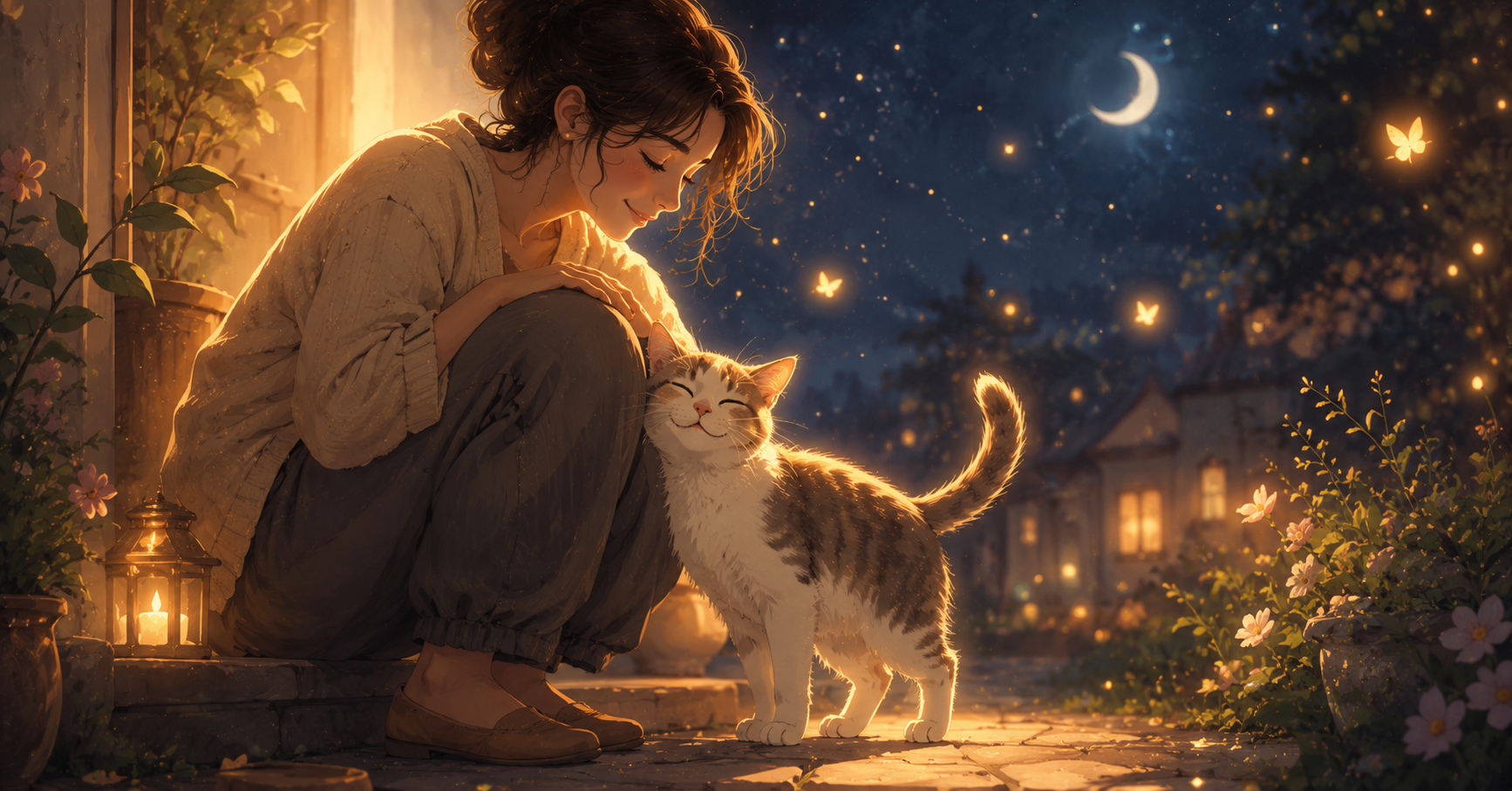
It arrives without announcement. One evening, a thin, quiet cat appears on your doorstep — eyes steady, unhurried, as though it has always known exactly where it was going.
You offer it nothing, say nothing, and yet it stays. It returns the next morning. And the next. Something about the moment feels less like coincidence and more like delivery.
If you have ever experienced this, you already sense that the question isn’t simply whether to feed it — it’s whether something larger is reaching out through it.
Uncovering the when a stray cat chooses you spiritual meaning opens a door that cultures across the world have been walking through for thousands of years.
This is not a modern fascination with animal symbolism. It is an ancient, cross-cultural recognition that cats — particularly strays who arrive unbidden and refuse to leave — carry meaning that reaches beyond the physical world.
The experience touches on guardianship, the kind that shields a home and its people from unseen harm. It touches on ancestral connection, the belief that those who have passed can communicate through the creatures who wander freely between worlds.
It involves the clearing of negative energy and the protection of your personal aura. It is woven into the folk wisdom of grandmothers, the sacred texts of ancient civilizations, and the living spiritual traditions of cultures from West Africa to Japan to the Celtic highlands.
Before you decide whether this cat simply needs a meal or whether it is meant to stay, it is worth understanding what humanity has always believed it is truly carrying to your door.
Ancient Guardians — How Civilizations Across Time Recognized the Cat as a Chosen Messenger
Long before the modern world reduced cats to household pets or internet curiosities, ancient civilizations built entire spiritual frameworks around them.
From the banks of the Nile to the fog-covered hills of Celtic Ireland, cats were understood as creatures who did not fully belong to the human world — and that liminality was precisely what made them sacred.
When a stray cat arrived at someone’s home uninvited, it was rarely dismissed as wandering hunger. The spiritual meaning of a stray cat coming to your house was, across vastly different cultures and centuries, interpreted as a deliberate visitation — a message carried on four quiet paws from a realm beyond ordinary perception.
Egypt: The Living Face of the Divine
No civilization codified cat veneration more completely than Ancient Egypt. The goddess Bastet — depicted as a cat or a woman with a cat’s head — was one of Egypt’s most beloved deities, worshipped as a protector of the home, a guardian of women and children, and a fierce defender against evil spirits and disease.
Domestic cats were considered her living embodiments. Killing one, even accidentally, was punishable by death. When a stray cat appeared at an Egyptian household, it was not seen as a homeless animal seeking shelter — it was understood as Bastet herself extending her protection over that family. The cat’s arrival was an honor, and its presence was treated accordingly.
Celtic and Norse Traditions: Guardians at the Threshold
Celtic spiritual tradition placed enormous significance on threshold spaces — doorways, crossroads, and borders between the known and unknown.
Cats were regarded as guardians of exactly these in-between places, creatures capable of perceiving and navigating what humans could not see.
A cat that appeared at your door was considered a sentinel positioned at the boundary between the living world and the spirit realm.
In Norse mythology, the connection between cats and the divine took a different but equally powerful form. The goddess Freyja — associated with love, fertility, magic, and war — rode a chariot pulled by two large grey cats. These were not decorative symbols.
In Norse cosmology, Freyja was one of the most powerful practitioners of seiðr, a form of magic centered on perceiving and shaping fate. Her cats, by direct association, were creatures tied to magical sight, feminine power, and the weaving of destiny.
The throughline across Egypt, the Celtic world, and Norse tradition is impossible to ignore: cats were never ordinary. Their arrival was never accidental. And the reverence these civilizations poured into that belief did not vanish when their temples fell — it traveled forward, shape-shifting into the spiritual and folk traditions that still carry it today.
The Spiritual Architecture of Being Chosen — What Your Energy Signals to a Stray
History tells us that cats are sacred. But it doesn’t fully answer the question that lingers in the back of every person’s mind when a stray fixes its gaze on them and refuses to move on: why me?
Spiritual traditions across the world offer a remarkably consistent answer. Cats — particularly strays who have survived entirely on instinct — are believed to perceive what humans cannot consciously access.
They sense auras, read emotional frequencies, and respond to psychic openness with an accuracy that no training explains. Where a person carries light, warmth, or a particular kind of energetic receptivity, a spiritually attuned cat will find it, often traveling distances that defy practical explanation to arrive at exactly the right threshold.
This means that being chosen is not a random fortune. It is a reflection. The cat’s selection of you speaks directly to your current spiritual state — your vibrational frequency, your emotional landscape, and the particular phase of life you are moving through.
The persistent question of whether a stray cat choosing you is good luck or bad luck fundamentally misframes the encounter.
The cat is not an omen arriving from outside your reality. It is a mirror appearing within it, showing you something about the energy you are currently emitting and the spiritual attention that energy has attracted.
When You Are in Transition, They Come Closer
Spiritual practitioners and animal behaviorists alike have noted a striking pattern: strays appear most persistently around people experiencing grief, major life change, or the early stages of a spiritual awakening.
These threshold states — the loss of a loved one, the end of a relationship, a career collapse, or the unsettling opening of psychic sensitivity — produce an energetic signature that appears to draw cats with unusual intensity.
In many traditions, this is understood as the universe deploying a guardian precisely when the human soul is most exposed and most receptive to contact.
A woman in the Philippines who lost her mother and found a stray appearing nightly at her window for forty days is not an isolated anecdote — it is a pattern repeated across cultures and continents.
The cat does not arrive despite your vulnerability. In many spiritual traditions, it arrives because of it, drawn by the opening that grief or transformation creates in your energetic field.
Understanding why you were chosen naturally raises the next question: who, exactly, sent it?
Messengers from the Other Side — Stray Cats as Vessels of Ancestral Communication
In many of the world’s oldest spiritual traditions, the dead do not simply disappear. They transition into a different form of presence — one that occasionally reaches back toward the living through the creatures who move most freely between worlds.
The spiritual meaning of a cat choosing you and your ancestors is deeply intertwined across West African, Indigenous American, and numerous Asian traditions, all of which recognize animals as legitimate vessels of ancestral communication.
A stray cat that selects a specific person, lingers without a practical explanation, and resists all attempts to redirect it is not always understood as a homeless animal in need. It is sometimes understood as a delivery — a loved one’s presence wrapped in fur, arriving with intention.
This interpretation carries particular weight when the chosen person is grieving, approaching an anniversary of a loved one’s death, or navigating a life decision the ancestor would have had strong feelings about.
In Yoruba spiritual tradition, animals appearing repeatedly around a person in mourning are considered potential emissaries from the ancestral realm — the Egungun — sent to offer protection and signal continued watchfulness from the other side.
Similar beliefs exist in Japanese folk spirituality, where cats are associated with the spirits of the deceased and are thought to linger near those who need ancestral guidance most.
Reading the Messenger: Behavioral Signs of Ancestral Presence
Not every stray carries an ancestral message, and spiritual traditions offer specific behavioral markers to help discern the difference.
Prolonged, unblinking eye contact — particularly at moments of emotional intensity — is widely interpreted as a spirit attempting direct communication.
A cat that gravitates toward sleeping areas and purrs consistently near the head or chest of a grieving person is considered, in several Southeast Asian and West African traditions, to be performing an act of spiritual comfort on behalf of someone who has passed.
Perhaps most striking is the pattern of appearance around significant dates — birthdays, death anniversaries, or culturally sacred days — when ancestral communication is already understood to be more accessible.
When a stray arrives on the birthday of a grandmother who adored cats, sits precisely where she used to sit, and refuses to leave until morning, the family members who feel something beyond coincidence are not being irrational. They are participating in one of humanity’s oldest and most cross-cultural forms of spiritual recognition.
Once the ancestor has made contact, the cat does not simply sit idle. It goes to work — and what it does next within your energetic space is perhaps its most powerful function of all.
The Cleansing Arrival — How Cats Absorb Negative Energy and Purify Sacred Spaces
A cat does not simply inhabit a space. According to a remarkably wide range of spiritual traditions, it actively works within it.
Cats are broadly understood as psychic sponges — creatures capable of absorbing stagnant, hostile, or spiritually corrosive energy that accumulates in homes, rooms, and around the human aura itself. This is not a fringe belief held by a single culture.
It is a consistent thread running through Slavic folk tradition, Japanese spiritual practice, Chinese metaphysical systems, and the lived experience of energy workers and spiritual healers across the modern world.
When a stray cat chooses your home, it may be doing far more than seeking shelter — it may be initiating a process of psychic protection and negative energy clearing that your space has been quietly needing.
In traditional Slavic households, a cat was always the first living creature to walk through the door of a new home before any family member entered.
This was not superstition for its own sake — it was deliberate energetic preparation. The cat was trusted to absorb and neutralize whatever residual or hostile energy occupied the space, rendering it safe for human habitation.
In Japan, the beckoning cat figure — the Maneki-Neko — is a direct cultural descendant of the belief that cats ward off evil spirits and attract protective, harmonious energy.
Within Feng Shui practice, a cat’s natural tendency to seek out and rest in energetically charged corners, doorways, and transitional spaces is interpreted as an instinctive response to energy imbalances the animal perceives and works to correct.
Recognizing When a Cat Is Actively Cleansing Your Space
Cats engaged in energetic work behave in ways that are distinctly different from ordinary rest or play. Sitting motionless in corners — particularly where walls meet, where energy is believed to pool and stagnate — is one of the most recognized signs.
Positioning themselves at thresholds, doorways, and windows places them at the exact boundary points where external energy enters a home.
A cat that stares with focused intensity at an apparently empty area of a room is, in many spiritual traditions, perceiving and addressing an energetic presence invisible to human eyes.
Perhaps most telling is the pattern of sudden agitation — pacing, vocalizing, or erratic movement — followed by a pronounced calm that settles over both the cat and the surrounding space. Energy workers often describe this sequence as the completion of a cleansing cycle.
When the stray that chose your doorstep begins gravitating to the corners of your bedroom or sitting squarely in your entryway each evening, it may be worth considering that it is not simply finding comfortable spots.
It may be finding the places that need it most. And if that cat happens to be black, the spiritual significance of its work carries an even deeper and more widely misunderstood power.
Shadow and Light — The Misunderstood Spiritual Power of the Stray Black Cat
Western culture has spent several centuries doing the black cat a profound disservice. The association with witchcraft, bad luck, and dark omens that took hold during the European medieval period represents one of the narrowest and most historically recent interpretations of an animal that the rest of the world has long regarded with reverence, awe, and deep spiritual respect.
When the full global picture is considered, the stray black cat’s spiritual meaning emerges not as a warning but as one of the most potent and layered spiritual encounters a person can experience — an invitation into heightened psychic protection, an initiation into mystery, and a powerful call toward shadow work and self-understanding.
Scotland and Ireland never absorbed the Continental European fear of black cats. In both traditions, a black cat appearing at your door or crossing your path was a firmly positive omen — a signal of incoming prosperity, good fortune, and protective energy taking up residence in your life.
Scottish fisher families historically welcomed black cats into their homes with particular enthusiasm, believing their presence guaranteed safe returns from sea.
In Japan, black cats carry some of the strongest protective symbolism in the entire Maneki-Neko tradition, believed to ward off stalkers, evil spirits, and misfortune with exceptional force.
And in Ancient Egypt, all cats were sacred to Bastet — but black cats, cloaked in the color associated with the fertile Nile soil and the regenerative darkness of creation, were considered especially powerful manifestations of her protective and magical energy.
When a Black Stray Refuses to Leave — Guardianship, Not a Visit
There is a meaningful spiritual distinction between a black cat that passes through your life and one that plants itself in it. A single appearance carries symbolic weight — a message, a momentary blessing, an energetic acknowledgment.
But a black stray that returns daily, that waits at your door, that follows you from room to room and resists every gentle redirection, is operating within an entirely different spiritual category.
This is not a visit. Across Celtic, Egyptian, and Japanese traditions alike, this behavior is recognized as the establishment of a guardian bond — the cat actively choosing to anchor its protective energy to you and your space specifically. It is not lost.
It has arrived. The shadow it carries is not darkness meant to harm you. It is the deep, fertile darkness that precedes transformation — and it has decided you are ready for what comes next.
The beliefs surrounding black cats did not emerge in isolation. They were shaped, preserved, and passed forward through generations of folk wisdom and cultural heritage — and that living tradition has far more to teach us than any medieval superstition ever could.
Folk Wisdom and Cultural Heritage — What Grandmothers Knew About the Cat at the Gate
Long before spiritual beliefs were organized into texts, temples, or formal doctrine, they lived in kitchens. They were carried in the voices of grandmothers, the quiet instructions of village healers, and the accumulated observations of elders who had watched life closely enough to recognize its patterns.
Folk wisdom is not primitive spirituality — it is preserved spirituality, refined across generations of direct experience and passed forward through story, ritual, and practical guidance.
And in nearly every folk tradition that has left a record, the spiritual meaning of a stray cat coming to your house was treated not as a curiosity but as an event — one that called for a considered, respectful response.
In Filipino folk tradition, a stray cat arriving at the home and refusing to leave is widely regarded as a sign of incoming blessing or a signal that the household is under spiritual watch.
Older generations in the Ilocos Region and across the Visayas would observe the cat’s behavior before concluding — noting which direction it came from, where it chose to rest, and whether it seemed calm or agitated within the space.
Feeding the cat was considered not just an act of kindness but a ritual of acceptance, an acknowledgment to whatever force had sent it that the household was willing to receive what was being offered.
Eastern European folk tradition prescribed a waiting period — commonly three days — before any final decision about a stray’s permanence was made.
This was understood as a discernment window, a time to observe whether the cat’s energy settled harmoniously into the home or whether its restlessness signaled a warning rather than a blessing.
In South Asian households, particularly within Hindu folk practice, a cat entering a home uninvited was often interpreted as Lakshmi — the goddess of fortune — sending an emissary, and the animal was fed milk and treated with deliberate reverence.
Latin American curandera tradition similarly recognized the arriving stray as a potential spiritual ally, with some healers naming the cat immediately upon arrival as an act of energetic anchoring — a way of formally welcoming the protection being extended.
What unites these traditions across vast geographic and cultural distances is the shared instinct that the correct response to a chosen cat is never indifference. The grandmothers knew that to ignore it was to refuse a gift. To receive it consciously, however — that was where the real spiritual work began.
Awakening the Guardian Bond — How to Spiritually Receive a Cat That Has Chosen You
Across every tradition explored in this article, one principle holds consistently: the chosen cat is not a passive symbol to be admired from a distance.
It is an active spiritual participant in a relationship that requires something from you in return. Folk healers, ancestral wisdom keepers, and modern energy practitioners all frame the encounter with a chosen stray not as an event to simply witness but as an invitation to respond — consciously, intentionally, and with the understanding that how you receive the cat shapes the nature of the bond being formed between you.
The first act of conscious reception is physical and symbolic simultaneously. Creating a welcoming threshold — a designated space near your entry where the cat can rest safely — is understood in numerous traditions as a formal signal to both the animal and the spiritual forces working through it that their presence is honored and accepted.
This need not be elaborate. A clean bowl of water, a folded cloth, a quiet corner near the door: these are acts of energetic acknowledgment as much as practical hospitality.
Following this, many spiritual practitioners recommend a personal aura cleansing in response to the cat’s arrival — using salt, smoke, sound, or intention-based meditation — not because the cat brings contamination, but because receiving a guardian clearly requires that your own energetic field be as open and unobstructed as possible.
The bond, once formed, is reciprocal in nature. The cat extends psychic protection and negative energy clearing toward you and your home.
You extend safety, consistent nourishment, and energetic respect in return. Disrupting this reciprocity — through neglect, hostility, or energetic carelessness — is understood in Celtic and Asian traditions alike as a dissolution of the protective contract.
Discernment: Chosen or Simply Hungry?
Not every stray that approaches your door is extending a spiritual invitation, and wisdom traditions are careful to acknowledge this. A cat motivated purely by hunger will typically lose interest once fed and will show no particular attachment to you as a person — it engages with the food, not with your presence.
A spiritually chosen cat behaves differently in ways that are difficult to dismiss. It seeks eye contact deliberately and holds it. It gravitates toward you specifically in a group of people. It returns consistently regardless of whether food is offered.
It positions itself near you during emotionally significant moments — during grief, during prayer, during periods of stress — with a calm, anchored presence that feels less like animal instinct and more like conscious companionship.
Trust that distinction. Your instincts about the difference are themselves part of the spiritual intelligence the encounter is designed to awaken.
Everything you have now learned — from Egypt’s sacred temples to your grandmother’s gate — converges in one final, quietly astonishing truth.
Conclusion — When the Cat Stays, the Universe Is Speaking Directly to You
Think back to that image: a thin, quiet cat on your doorstep, eyes steady, refusing to move on. You understand now that the moment carries far more weight than it appeared to.
That cat was not lost. It was not simply hungry. It arrived at your threshold carrying the accumulated spiritual recognition of thousands of years and dozens of civilizations — all of which looked at this exact encounter and said: pay attention.
When a stray cat chooses you, it is rarely one thing. It may be an ancestor reaching forward through the only vessel capable of crossing that distance.
It may be a guardian responding to the energetic frequency your grief, your awakening, or your transformation has been quietly broadcasting.
It may be the universe’s answer to the question of whether a stray cat choosing you is good luck or bad luck — and the answer, as ancient Egypt, Celtic Ireland, and your own grandmother’s folk tradition all confirm, is neither. It is a mirror. It is a messenger. It is psychic protection and negative energy clearing made visible, warm, and present in your home.
The spiritual meaning of a stray cat coming to your house has always been available to those willing to receive it consciously. The cat chose you. Now you get to choose what that means — and what you do next with the guardianship being offered.