

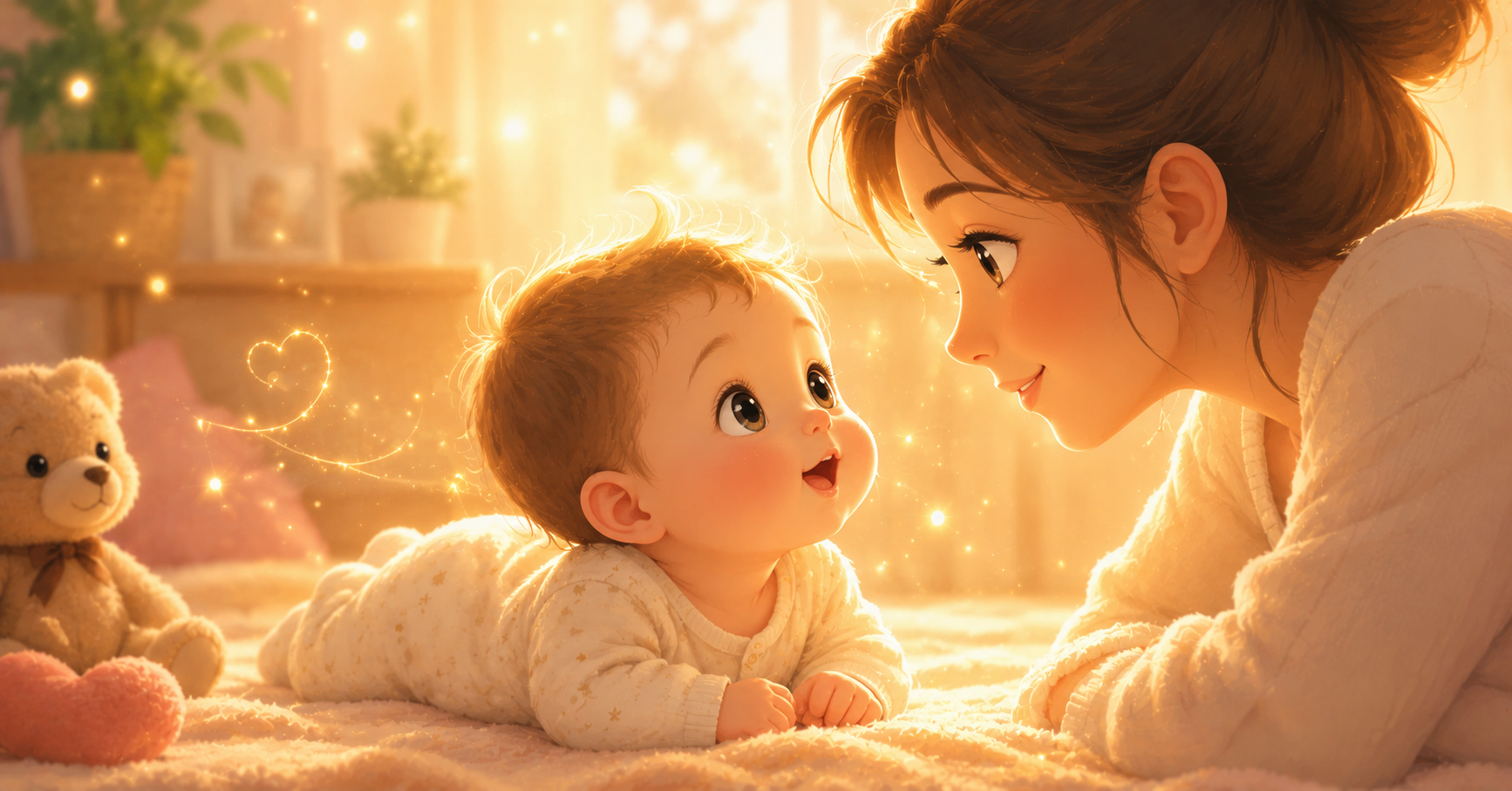
There is something about the moment a baby locks eyes with you that stops you mid-sentence. Not a glance — a gaze. Steady, unhurried, and oddly knowing, as if they are reading something in you that you have never been able to read in yourself.
If you have ever caught yourself looking for the deeper truth behind a child’s gaze, uncovering the why do babies stare at me spiritual meaning is often the first step in understanding your own energetic presence. That quiet, wordless exchange has a way of staying with you long after the moment passes.
Growing up immersed in Zulu and Xhosa culture, this was never a mystery that needed explaining — it was simply understood. Babies are regarded as innocent beings who can sense what adults have long since learned to overlook, including the presence of spirits and the true nature of the people around them.
The interpretation was clear and consistent: if a baby stared at a stranger and became frightened or unsettled, it was understood that something in that person’s spirit was not in alignment with the baby’s own pure energy.
But if the staring was calm, curious, and open — the kind that lingered without fear — it was taken as a quiet confirmation that the person carried a spirit that was clean, safe, and resonant with the child’s own.
There was no debate about it, no need to rationalize it away. The baby’s reaction was simply trusted as one of the most honest forms of discernment available.
Before we go deeper, it is worth grounding this conversation in something honest: babies are developmentally wired to be drawn to faces, high contrast, and movement.
Science has a reasonable, well-documented explanation for why infants stare, and not every lingering look carries a message from beyond. Acknowledging that actually matters here — because what remains after the developmental explanation is accounted for is exactly what this article is about.
Because here is what science does not fully explain: why certain people — strangers in a grocery store, quiet people sitting across a room, people who have said nothing and done nothing to invite attention — are the ones babies cannot seem to look away from.
That pattern is older than modern psychology. It shows up in ancient texts, in indigenous oral traditions, in the lived experience of people across every culture on earth. And it may be telling you something worth hearing.
The Unspoken Language — What Babies Are Actually Perceiving Beyond the Physical
Before a child learns a single word, before social conditioning has had even a moment to take hold, an infant is already doing something remarkable — perceiving the world in its rawest, most unfiltered form. They have no learned biases, no practiced politeness, and no reason to look away from what they sense. What they respond to is not performance. It is presence.
Many spiritual traditions hold that newborns and very young babies exist unusually close to the threshold between the physical and the unseen — that the veil most adults cannot perceive is still remarkably thin for them.
They have not yet been taught to rationalize away what they feel or to ignore what they cannot explain. In that sense, they may be the most honest witnesses in any room.
This is why, if you have ever asked yourself why random babies stare at me — people I have never met, in places I least expect it — the answer may have little to do with your appearance and everything to do with your energy.
A baby in a shopping cart three aisles away who turns and fixes their gaze on you is not reacting to your face. They may be responding to what surrounds you: your emotional frequency, the quality of your presence, the invisible signature that travels with you wherever you go.
That invisible signature has a name in nearly every spiritual tradition on earth — and it may be exactly what babies are seeing.
Can Babies See Your Aura — The Spiritual Science Behind the Stare
The idea that human beings radiate an energy field extending beyond the physical body is not a fringe concept invented by modern wellness culture.
It is one of the most consistent beliefs across the entire span of human spiritual history — described in Vedic texts as prana, mapped through the chakra system in Hindu and Buddhist traditions, referenced in Sufi mysticism, and recognized in indigenous cultures across every inhabited continent. The language differs. The underlying belief does not.
So when people sincerely ask: can babies see your aura — the honest answer, through a spiritual lens, is that they may be among the few who still can.
Adult perception tends to narrow over time, shaped by logic, skepticism, and a lifetime of being told to trust only what can be measured. Babies carry none of that conditioning.
Their perceptual field is wide open, and many spiritual teachers and traditions suggest that what adults have learned to filter out, infants absorb naturally and completely.
If a baby is consistently drawn to you, the spiritual interpretation across these traditions points to something specific about the quality of your energy field — a brightness, a steadiness, or a warmth that registers as safe, familiar, or resonant to a being whose own energy is still entirely pure.
Like frequencies finding each other across a room, the baby may simply be responding to something in you that matches something in them.
Which raises a question even more striking than the stare itself — what happens when that recognition breaks into a smile?
When a Baby Stares and Smiles — The Moment Spiritual Recognition Becomes Undeniable
There is a version of this experience that goes beyond the stare — and if it has happened to you, you already know exactly what it feels like. A baby you have never met holds your gaze, and then, slowly and completely unprompted, breaks into a full, open smile.
Not a reflex. Not a response to a funny face or a familiar voice. Just recognition — quiet, certain, and aimed directly at you. It is the kind of moment that makes even the most grounded person pause.
When people ask what it means when a baby stares at you and smiles spiritually, they are often reaching for language to describe something that already felt significant before they could explain why.
And across virtually every spiritual tradition that addresses this experience, the smile is treated as something categorically different from the stare alone. Where the stare may signal perception, the smile signals recognition — a soul responding to something it knows.
The frameworks vary but point in the same direction. Some traditions describe it as the acknowledgment of a soul contract — two beings who agreed, before this lifetime, to find each other again.
Others interpret it as a karmic greeting, a moment where energetic familiarity surfaces through an infant who has not yet learned to suppress what they feel.
In angelic and ancestral belief systems, the unprompted smile is sometimes understood as a greeting passed through the baby from a presence watching over you both.
What makes this especially worth paying attention to is the adult’s response. Most people describe the same thing: a sudden warmth in the chest, an inexplicable sense of being genuinely seen, and occasionally, tears they cannot fully account for. That involuntary reaction may not be a coincidence — it may be recognition answering recognition.
This experience has not gone unnoticed throughout human history. Across cultures and centuries, it has been documented, named, and held as something sacred.
Written in Every Culture — What Ancient Traditions and World Religions Say About Babies and Spiritual Sight
If you have been searching for the spiritual meaning of babies staring at you, you may have assumed this curiosity is a recent one, born from social media discussions or modern spiritual communities.
It is not. The belief that infants possess a form of perception unavailable to most adults is among the oldest and most widely shared convictions in human history, appearing independently across civilizations that had no contact with one another and no shared language for what they were observing.
Eastern Spiritual Traditions
In both Hindu and Buddhist thought, a newborn arrives still carrying the energetic imprint of previous incarnations.
The soul is understood to be ancient even when the body is hours old, and an infant’s intense, unbroken gaze at a stranger is often interpreted as the recognition of a soul encountered in a former life — familiarity surfacing before the conscious mind has formed enough to suppress it.
Abrahamic and Angelic Frameworks
Within Christian mysticism, Islamic tradition, and Kabbalistic Jewish thought, infants are described as existing in unusually proximity to the divine.
Some traditions hold that angels attend newborns directly, and that a baby’s gaze into what appears to be space — or their calm, focused attention on a particular person — may reflect an awareness of presences that older, more conditioned eyes can no longer detect.
Indigenous and Earth-Based Wisdom
Across indigenous traditions from West Africa to the Americas to the Pacific Islands, infants are widely regarded as spiritually awake in ways adults are not.
Many of these traditions teach that babies can perceive ancestral spirits, read the energy of the living, and sense the integrity of a person’s soul long before any behavior confirms it.
An elder in many of these cultures would not dismiss a baby’s reaction to someone — they would treat it as information.
Despite the vast geographic and cultural distances separating these traditions, the conclusion they each arrive at is strikingly identical: babies see what the rest of us have spent a lifetime learning to overlook.
And if that is true, it raises a natural question — are certain people seen more clearly than others? For those who identify as empaths or energetically sensitive, the answer appears to be yes.
Why Empaths and Energetically Sensitive People Are Stared at Most
If babies respond to energy rather than appearance or behavior, then it follows that not all energy fields would draw the same level of attention.
Some people move through the world radiating something wider, warmer, and more perceptible than average — and the evidence across spiritual traditions suggests that infants notice this immediately and instinctively.
The question of whether babies can sense an empath comes up consistently in spiritual communities, and not as abstract theory.
It comes up because empaths keep reporting the same experience, independently, across cultures and contexts: babies they have never encountered fix on them from across rooms, in public spaces, before any interaction has taken place. Not a glance. A sustained, searching gaze that feels less like curiosity and more like identification.
What empaths carry energetically is distinct. A wide-open emotional field, a high sensitivity to the feelings and frequencies of others, and a quality of presence that tends to feel — to those who can perceive it — both expansive and deeply safe.
For a baby operating entirely on energetic instinct, that kind of field may register as something recognizable. Something that feels like home.
This is importantly different from simply being warm, friendly, or naturally comfortable around children.
Empaths often report that the staring begins before they have smiled, spoken, or acknowledged the baby in any way. The baby reacts not to what the empath does — but to what the empath is.
If babies are consistently drawn to you in this way, it may be pointing to something far more significant than a personality trait — it may be a reflection of where you are on your own spiritual path.
Baby Staring Into Space — When the Gaze Is Not Meant for You at All
Not every intense infant gaze is aimed at a person. Anyone who has spent time around a young baby has likely witnessed it — that sudden, focused stillness directed at an empty corner, a blank stretch of wall, or a patch of open air. The baby is not confused or distracted.
They are looking at something with the same quality of attention they might give a face they recognize. Understanding the baby staring into space spiritual meaning requires treating this experience with the same seriousness as any other form of infant perception.
Across spiritual traditions worldwide, this particular behavior is among the most consistently noted and most tenderly interpreted.
In many cultures, a baby gazing intently at what appears to be nothing is understood as evidence of a presence the rest of the room simply cannot perceive — an ancestor pausing nearby, an angel fulfilling a protective role, or the lingering warmth of a loved one who has passed.
The baby, still unburdened by the skepticism that comes with age, simply looks directly at what is there.
Nothing is alarming in this. If anything, it is one of the quieter and more beautiful reminders that the world may be far more populated with presence than our adult senses allow us to confirm.
Each of these experiences — the locked gaze, the unprompted smile, the empathic recognition, the stare into open space — is pointing toward the same underlying truth, and it may be one of the most affirming things you ever allow yourself to consider.
What It Means for You — Reading the Message Babies May Be Sending Your Soul
Understanding the spiritual framework is one thing. Allowing it to turn inward — to actually sit with what it might mean for you personally — is another.
If babies stare at you with unusual frequency or intensity, the spiritual meaning is worth reflecting on, not as a novelty, but as a genuine signal about who you are and where you are in your own unfolding.
Consider this an invitation rather than a conclusion. There are several ways this experience tends to speak, and only you will know which one resonates most honestly:
You may carry a frequency of safety, warmth, or healing that pure, unguarded souls recognize before a single word is exchanged. You may be in a period of your spiritual development where your energy is more elevated, more open, or more coherent than usual — and that elevation is perceptible to those without filters.
The experience may simply be a confirmation, a quiet and recurring reminder from the universe that your presence matters and that you are seen in ways you do not always see yourself.
Or it may be a gentle call to pay closer attention — to your gifts, your path, and the energy you are moving through the world with every day.
What these moments share is this: they are not random. Treating them as a coincidence is always an option, but so is receiving them as the soft, persistent affirmations they may genuinely be.
The question is not only what babies are seeing when they look at you — it is whether you are ready to see it too.
Conclusion — Trusting What Only the Purest Eyes Can Confirm
Come back, for a moment, to that original experience — a baby’s gaze finding yours across a room, unhurried and unbroken, carrying a weight that seemed far too deliberate for someone who has only been in the world for a handful of months. You felt something. And now you have a fuller sense of why that feeling made complete sense.
Across ancient traditions, world religions, indigenous wisdom, and the lived experience of empaths and spiritually sensitive people everywhere, the conclusion is remarkably consistent: babies do not respond to what we perform. They respond to what we are.
The spiritual meaning of babies staring at you, in whatever form it takes — the locked gaze, the sudden smile, the reaching across a crowded room — points to something in you that language has always struggled to name but that pure souls have never had trouble finding.
Not every stare is a message. But the pattern so many people notice is real, it is ancient, and it is worth honoring.
Some things can only be confirmed by eyes that have not yet learned to stop seeing. When a baby looks at you that way, perhaps the wisest response is simply to receive it — and trust what it reflects.
If this experience resonates with you, share your story in the comments below. And if you are drawn to explore further, there is much more waiting for you here.