

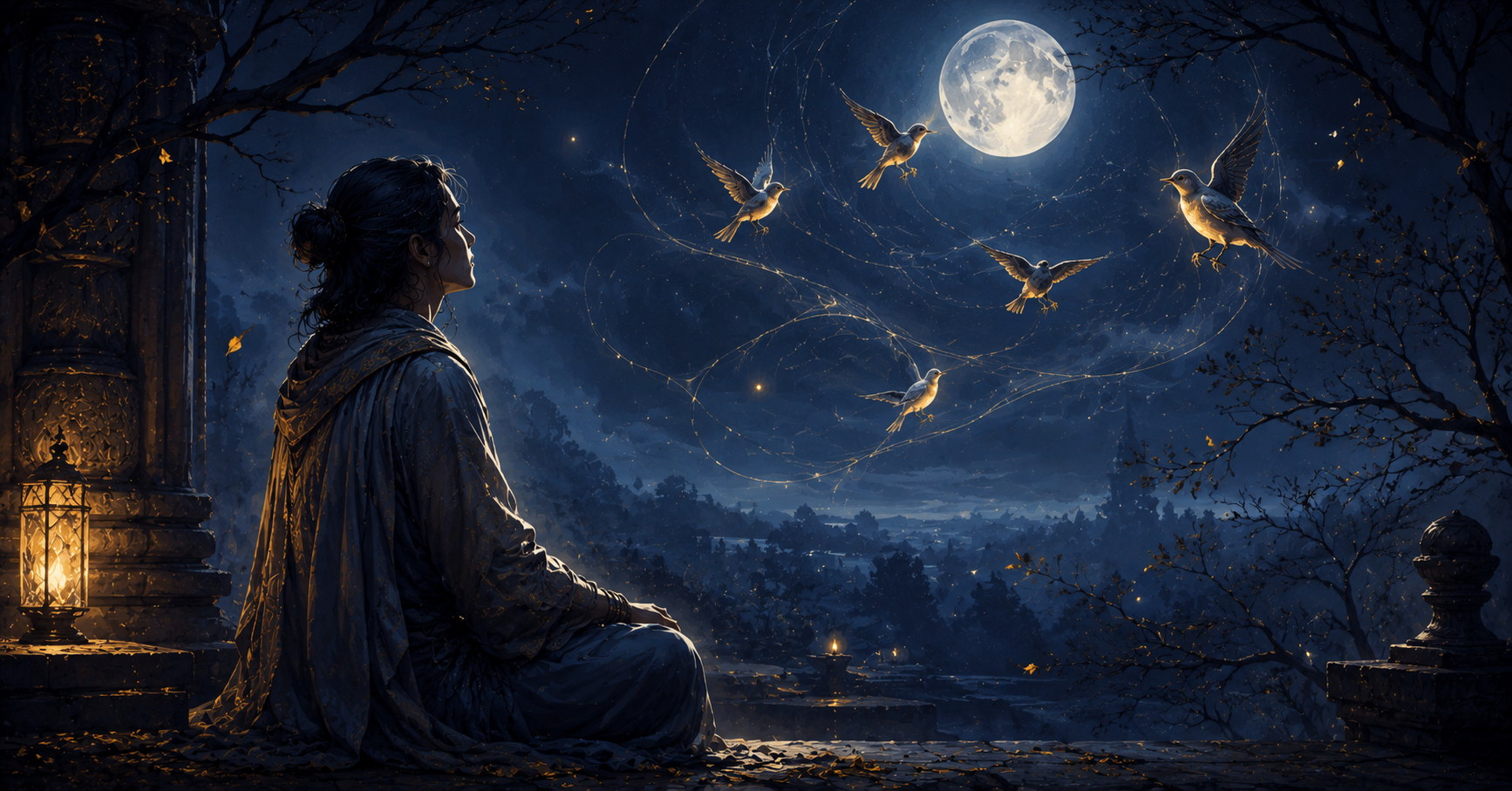
It is 2 a.m. The house is still, the street is empty, and somewhere just beyond your window, a bird begins to sing. Not a sleepy murmur — a full, deliberate song cutting through the silence with an urgency that feels almost personal. You lie there, suddenly alert, wondering what it means.
You are not alone in that wondering. For as long as humans have tracked the stars and tended fires through the dark hours, uncovering the why do birds chirp at night spiritual meaning has occupied mystics, grieving mothers, Indigenous elders, and ordinary people who could not shake the feeling that something was being communicated.
The sensation sits at an uncomfortable crossroads — part wonder, part warning — and that tension is exactly what makes nocturnal birdsong one of the most enduring spiritual symbols across human civilization.
Is the bird a messenger from a loved one who has passed? A signal that your own spiritual awareness is expanding? A centuries-old omen your ancestors would have recognized immediately? Or simply nature, indifferent and beautiful, filling the night with sound?
The answer, as with most things that matter spiritually, is not a single note. It is a chord — built from Egyptian mythology, West African ancestor traditions, Christian mysticism, Indigenous cosmology, and the lived intuition of people who have learned to listen when the ordinary world goes quiet.
To understand what the night bird is saying, we must first understand how ancient the conversation truly is.
Ancient Voices — What History and Religion Say About Birds Calling in the Dark
The instinct to assign meaning to a bird singing in darkness did not begin with social media spirituality or modern metaphysics. It began in the oldest civilizations on earth, among people who understood the natural world as a living language — and who believed that language spoke most clearly when the sun was down.
In ancient Egypt, the soul itself was depicted as a bird. The ba — one of the key components of the human soul — was illustrated as a human-headed bird that could leave the body during sleep and travel between worlds. A bird calling at night, then, was not merely an animal behaving oddly.
It was potentially a soul in transit, a spirit making contact, or a divine signal from the realm of the dead. The Egyptians took such signs seriously enough to employ professional dream interpreters and omen readers in their temples.
Greek oracular tradition held that birds were the preferred messengers of the gods, with Zeus himself communicating through the eagle and Athena through the owl.
The appearance or cry of specific birds after dark was carefully noted by augurs — priests trained in the art of reading avian behavior as divine instruction.
Roman augury formalized this into state policy. Military campaigns were delayed, elections were postponed, and political decisions were reversed based on the calls of birds observed at the wrong hour or in the wrong direction.
The Omen Tradition — When Night Birds Were Considered Warnings
The idea of hearing birds chirping at night as a bad omen is not folklore born from fear — it is a structured interpretive tradition with deep institutional roots.
In early Christian communities across medieval Europe, an owl’s cry outside a window at night was widely understood as a harbinger of death or illness in the household.
Indigenous animist traditions across North America and sub-Saharan Africa held similar frameworks: certain birds, singing at certain hours, were urgent dispatches from the spirit world demanding attention, preparation, or prayer.
These were not superstitions to be dismissed. They were a community’s early warning system, encoded in generations of careful observation and spiritual discernment.
The 3 A.M. Phenomenon — Why the Witching Hour Amplifies Every Song
Not all nighttime hours carry equal spiritual weight. Ask anyone who has been startled awake in the deep dark, and they will often report the same timestamp: 3 a.m.
There is something about that particular hour that does not feel accidental — and across an extraordinary range of spiritual traditions, it isn’t.
The hearing of birds chirping at 3 a.m. and the spiritual meaning attached to it represents one of the most concentrated intersections of natural behavior and sacred symbolism in the human experience.
The explanation begins with what mystics, monks, and spiritual practitioners across centuries have called the thinning of the veil.
This is the belief that the membrane separating the physical world from the spiritual realm becomes most permeable in the hours between 3 and 4 a.m. — a window when the noise and energy of human activity have fully withdrawn, and the spirit world can make itself known most clearly.
Contemplative Christian tradition references this hour as spiritually charged, noting that 3 a.m. sits as the inverse of 3 p.m., the hour associated with the death of Christ — making it a time of heightened spiritual polarity.
In folk traditions from Appalachia to the Philippines, this is the hour when the dead are most likely to attempt contact, when dreams carry prophetic weight, and when signs in the natural world demand the most serious attention.
A bird that calls once at 3 a.m. and falls silent is widely interpreted as a single, clear message — a knock on the door of your awareness. But a bird that chirps persistently, cycling through its song repeatedly in that same witching hour, carries a different urgency entirely.
Many traditions read sustained nocturnal song as an insistent summons: something or someone is not willing to wait until morning. The message, whatever its origin, is pressing. It asks not just to be heard, but to be answered.
A Messenger at the Window — Decoding the Personal Signal
There is a meaningful difference between a bird singing somewhere in the trees down the street and a bird singing directly outside your window. Distance matters in the physical world, and it matters equally in the spiritual one.
The spiritual meaning of birds chirping outside your window carries a specificity that a distant song does not — because the window is not simply a pane of glass.
It is a threshold. In architectural symbolism across dozens of cultures, the window represents the boundary between your private inner world and the larger forces moving outside it.
When a bird crosses that threshold — not entering, but calling from its edge — the message is not general. It is addressed to you.
This proximity is precisely what elevates the experience beyond coincidence in the eyes of spiritual traditions worldwide. A bird has the entirety of the night landscape available to it. Trees, rooftops, open fields, and telephone wires stretch in every direction.
Its choice to perch at the boundary of your specific living space and sing is, in this framework, a deliberate act of communication — a spiritual dispatch delivered to the correct address.
The interpretive framework most appropriate to the message depends heavily on both tradition and personal context. A bird chirping outside the window of someone in the midst of grief is widely understood as a protective presence — a reassurance that they are not alone.
For someone facing a crossroads decision, the same experience may read as a call to attention, an instruction to pause before moving forward.
In some folk traditions, a bird arriving at the window just before dawn signals incoming news, not always welcome. In others, it is understood as a guardian spirit confirming that the household is being watched over.
What you bring to the window matters as much as what the bird brings. Your emotional state, your current season of life, and the specific losses or longings you carry will all shape the meaning that surfaces — because genuine spiritual signals do not arrive in a vacuum. They arrive in context, and they speak the language of your particular moment.
Blood and Memory — The Ancestral Tradition of the Night Bird’s Call
In the Western secular world, death is widely treated as an ending — a door that closes and does not reopen. But across the majority of human cultures throughout history, that understanding is the minority position.
For most of the world, across most of recorded time, the dead do not disappear. They transition. They remain invested in the lives of the families they left behind, and they communicate when communication is necessary.
Among the most trusted instruments of that communication, the bird singing at night as a message from ancestors stands as one of the most universal and consistently documented spiritual beliefs on earth.
In West African spiritual traditions, including those carried into the diaspora through Yoruba and Akan cosmology, birds occupy a sacred intermediary role between the living and the ancestral realm.
A bird appearing near a home at night — particularly one behaving unusually or persistently — is understood as a potential vessel for an ancestral presence. Families in these traditions do not dismiss such experiences.
They sit with them, consult elders, and offer prayers in response. In numerous Native American nations, including Cherokee and Ojibwe traditions, specific birds are understood as carriers of ancestral intelligence.
The arrival of such a bird during a time of family difficulty or important decision-making is treated as guidance from those who walked the lineage before.
Across East and Southeast Asian ancestor veneration practices, from Japan’s Obon traditions to Vietnamese ceremonial customs, birds appearing unexpectedly near the home — especially around memorial dates — are received as visits from beloved dead.
Discerning whether a nocturnal bird experience carries ancestral weight rather than a more general spiritual signal often comes down to three factors: timing, emotional resonance, and personal history.
If the bird appears near an anniversary of a loved one’s death, or during a family crisis, or at a moment when you have been actively thinking of someone who has passed, the ancestral interpretation deserves serious consideration.
The feeling itself is also instructive — many people who have had genuine ancestral encounters report not fear, but a sudden, inexplicable sense of recognition, as though something familiar has briefly returned to stand beside them in the dark.
The Awakening Signal — Birds, Psychic Sensitivity, and Spiritual Growth
There are periods in a human life when the ordinary world begins to feel unexpectedly thin — when coincidences stack too neatly to be dismissed, when dreams arrive with unusual clarity, and when the natural world seems to be leaning in, communicating in a register just beneath normal hearing.
These are the hallmarks of active spiritual awakening, and they are almost always accompanied by a sharpened sensitivity to signs in nature.
For many people moving through this threshold, nocturnal birdsong becomes one of the first and most consistent signals they notice — not because the birds have changed their behavior, but because the individual’s capacity to receive has fundamentally expanded.
Spiritual awakening and psychic sensitivity are not separate phenomena; they are the same opening, experienced through different senses.
Researchers in transpersonal psychology and practitioners in contemplative traditions alike have noted that people in active spiritual development consistently report heightened attunement to animal behavior, environmental synchronicities, and phenomena that cluster around sleep and the pre-dawn hours.
A person who would previously have rolled over and ignored a bird outside their window now finds themselves sitting up, paying attention, feeling the distinct sense that the sound carries weight.
This is not imagination manufacturing meaning. It is perception expanding into territory it previously could not access.
The shift in receptivity is the key variable. Birds do not suddenly begin visiting spiritually awakened people more frequently. What changes is the person’s ability to notice, interpret, and feel the significance of what was always present.
Signs You Are Receiving — Not Just Hearing — the Message
Psychic sensitivity, properly understood, is not an exotic gift reserved for a gifted few. It is a natural developmental stage that emerges when a person begins consistently quieting the mental noise that normally drowns out subtler forms of perception.
The signs that you are genuinely receiving a nocturnal bird’s message — rather than simply hearing ambient sound — tend to be consistent across accounts: a sudden feeling of stillness or alertness that precedes the bird’s call, an emotional response disproportionate to the sound itself, a sense of being specifically addressed rather than incidentally disturbed, and a lingering quality to the experience that ordinary sounds do not leave behind.
If the birdsong stays with you into the following day, returning to your thoughts unbidden, that persistence is itself a signal worth honoring.
Reading the Bird — Species, Patterns, and What They Signal
Not every night bird carries the same message, and discerning spiritual meaning with any depth requires moving beyond the general experience of nocturnal birdsong into two more specific questions: which bird, and in what pattern.
Across centuries of accumulated spiritual tradition, folk wisdom, and cross-cultural symbolism, both variables carry significant interpretive weight. The species shapes the nature of the message. The pattern shapes its urgency.
The owl is the most universally recognized nocturnal bird in spiritual traditions worldwide, though its meaning is more nuanced than popular culture suggests.
In Native American traditions, it is frequently associated with the souls of the recently departed, serving as both a death omen and a protective guide for transitioning spirits. In ancient Greek cosmology, the owl signaled wisdom and hidden knowledge.
An owl calling outside a home on a single night is widely interpreted as an awareness prompt — pay attention to what you have been avoiding. An owl returning on consecutive nights escalates that signal considerably toward warning.
The whippoorwill occupies a uniquely haunting position in Appalachian and Northeastern American folk tradition, where it was believed to hover near the dying to catch the soul at the moment of departure.
Its persistent, repetitive night call was treated as a direct sign that death was near a household or that a soul nearby remained unresolved and restless.
The mockingbird, singing its borrowed repertoire through the dark hours, carries a different spiritual signature entirely — one associated with truth, reflection, and the need to examine what is genuinely your own voice versus what you have absorbed from others.
The nightingale, celebrated across Persian poetry and European mysticism, has long represented divine longing and the sorrow that accompanies genuine spiritual seeking.
Pattern matters as much as species. A single, clean call followed by silence is widely interpreted as a clear and complete message — delivered and done.
Sustained, repetitive singing across an extended period suggests an insistent communication that has not yet been acknowledged.
A bird appearing outside your home on three or more consecutive nights, regardless of species, is treated in numerous traditions as a message that has graduated from invitation to instruction.
Responding to the Message — Grounding Practice and Spiritual Discernment
Receiving a spiritual sign is only half the experience. What you do with it determines whether the communication completes its arc or dissolves into unresolved noise.
Across every tradition examined in this article — from Roman augury to West African ancestral practice to contemplative Christianity — the recognition of a sign was never treated as the endpoint. It was the beginning of a response.
Spiritual discernment is not a passive state of open-minded wondering. It is an active, intelligent practice that requires the same quality of attention you would bring to any serious and consequential conversation.
The first step is stillness and intentional listening. When a bird wakes you at 3 a.m. or calls persistently outside your window, resist the immediate impulse to explain it away or, conversely, to dramatize it. Simply become still.
Breathe deliberately. Notice what you feel in your body before your mind has the chance to interpret — because the body registers spiritual signals before the intellect can categorize them. That initial, unfiltered physical response carries important information.
The second step is to journal the experience with full emotional context as soon as possible — ideally within the same hour.
Record not just what you heard, but what was happening in your life in the days preceding it, what you were thinking about before you fell asleep, and what emotion surfaced when the bird began to sing. Patterns only become visible when they are written down.
The third step is to consult the cultural or ancestral framework most native to your own lineage and spiritual background.
A Yoruba interpretive lens and a Celtic one will illuminate different facets of the same experience. Your heritage is not a limitation — it is a precision tool.
The fourth step, and perhaps the most difficult, is to sit with the message rather than forcing a conclusion. Meaning that it arrives too quickly, often meaning the mind has manufactured to resolve discomfort.
Genuine spiritual insight tends to settle slowly, deepening over days rather than arriving fully formed in a single night.
The night bird does not demand that you solve it. It asks only that you take it seriously — and in doing so, you begin to discover that its meaning lives not in any single tradition, but at the intersection of ancient wisdom and your own irreplaceable truth.
The Night Bird as Mirror, Messenger, and Mystery
The house is still again. The bird has stopped singing. But something in you has shifted — some quiet attentiveness that was not there before the song began — and that shift is precisely the point.
What this article has traced across cultures, centuries, and spiritual traditions is not a single answer to why birds chirp at night and what spiritual meaning that experience carries.
It is something more valuable: a unified framework built from many voices. The ancient Egyptians who saw the soul in every bird. The Roman augurs who paused military campaigns at an owl’s cry.
The West African elder who recognized an ancestor’s knock in a persistent night song. The person mid-awakening who sat up in the dark and felt, with quiet certainty, that they were being addressed.
These are not separate stories. They are the same story, told in different languages across an unbroken thread of human spiritual experience.
You were right to wonder. The instinct that made you pause, that kept the experience from dissolving into background noise, is itself a form of perception worth trusting.
The night bird does not always bring comfort, and it does not always bring warning. Sometimes it brings only the invitation to become someone who listens more carefully — to the world outside the window, to the lineage running through your blood, and to the quieter frequencies of your own deepening awareness.
The mystery does not ask to be solved. It asks to be honored.