

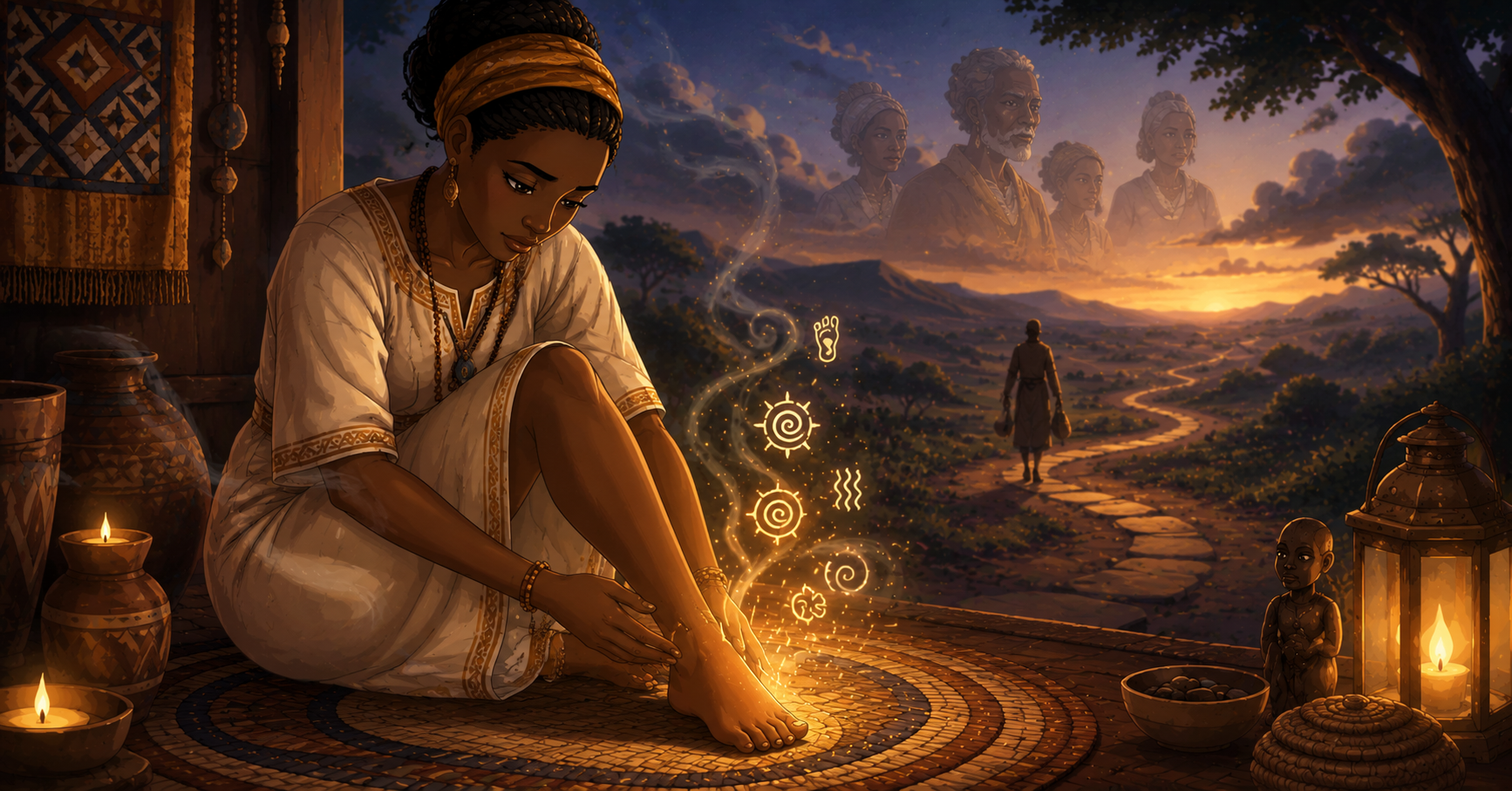
It starts without warning — a persistent, tingling itch on the bottom or top of your right foot, with no rash, no insect bite, and no reasonable explanation in sight. You scratch it, it fades, and then you are left wondering about the why is my right foot itching spiritual meaning.
For many people, that question doesn’t stop at the physical. Something about the sensation feels pointed, almost intentional — as if the body is trying to deliver a message the conscious mind hasn’t yet received.
Across centuries and continents, human beings have understood the body as far more than a biological machine. It has long been regarded as a living antenna — one that picks up spiritual frequencies, ancestral signals, and sacred direction that the logical mind routinely filters out.
An itch, a twitch, a sudden warmth in the chest — these were not dismissed as random nerve activity by our ancestors. They were read, interpreted, and acted upon as guidance from forces older and wiser than any single lifetime.
This article explores that wisdom through two complementary lenses: the ancient spiritual traditions that first gave these bodily omens their meaning, and the growing modern movement toward intuitive, body-aware living.
From West African cosmology and Indigenous Earth-centered beliefs to Chinese folk tradition and the universal language of ancestral memory, the itching right foot carries a surprisingly consistent message across cultures that never shared a map.
What follows is not a guide to superstition. It is an invitation to listen more carefully — to your body, to your lineage, and to the sacred path that may be quietly calling your name through the most unexpected of messengers.
The journey begins with understanding why the body speaks at all.
The Ancient Language of the Body — Why Physical Sensations Carry Spiritual Weight
Long before modern medicine reduced the human body to its chemistry, ancient civilizations operated from a radically different premise: the physical and the spiritual were never two separate things.
The body was not a container for the soul — it was the soul made visible. Every sensation, every involuntary signal the body produced, was considered data from a dimension beyond the purely material.
This understanding gave rise to what we might now call somatic spiritual signals — the involuntary twitches, tingles, sudden chills, and persistent itches that arise without obvious physical cause.
In ancient Egypt, Greece, China, and across the indigenous world, trained healers, priests, and elders could interpret these signals the way a navigator reads the stars: as precise, meaningful information about a person’s spiritual state, relational energies, and life direction.
An itch was never just an itch. It was a sentence in a language the body had been speaking long before words existed.
The feet, in particular, hold a position of profound sacred significance in this ancient body-language system. As the only part of the human body in constant contact with the Earth, the feet were understood as the primary interface between a person and the living world beneath them.
They are the carriers of every journey ever taken, the instruments of pilgrimage, migration, and purposeful movement. To feel something unusual in the foot was to receive a signal at the very foundation of one’s earthly walk.
Both Ayurvedic tradition and Traditional Chinese Medicine formalized this understanding. In reflexology — rooted in both systems — the feet are mapped with energetic zones corresponding to every organ, system, and life force in the body. The right foot, in particular, connects to forward-moving, outward energy.
Which raises the essential question this article returns to: when exploring the why is my right foot itching spiritual meaning, the answer begins not just with the foot — but with which foot, and why that distinction has mattered to every tradition that ever paid attention.
Right Versus Left — The Sacred Polarity That Changes Everything
In virtually every spiritual and cosmological system humanity has ever constructed, the body is not symmetrical in meaning — only in form.
The right and left sides carry distinct, opposing, and deeply intentional energetic signatures that have been recognized independently by cultures separated by oceans and millennia.
This is not a coincidence. It is convergence — multiple traditions arriving at the same truth through direct observation of the human experience.
The right side of the body has been consistently understood as the active, masculine, solar, and outward-moving force. It is the side of giving, initiating, projecting energy into the world, and stepping forward into new territory.
In Hindu tradition, the right side is governed by Pingala Nadi — the solar energy channel associated with action, vitality, and external engagement. In many African spiritual systems, the right side signals movement toward destiny.
In European folk tradition, leading with the right foot was a deliberate act of good omen when beginning a journey or entering a sacred space.
The left side, by contrast, is the receptive, feminine, lunar force — the side of incoming energy, intuition, and what is being drawn toward you. This polarity explains why the same itch on different feet carries entirely different messages across folk traditions worldwide.
When it comes to itchy right foot superstition meaning, the cross-cultural consensus is remarkably consistent: something is coming that requires you to move.
A journey is imminent. Good fortune tied to forward action is approaching. Unexpected travel — physical or spiritual — is being signaled.
These are not old wives’ tales born of idle imagination. They are encoded observations about directional energy that our ancestors tracked with the same seriousness as a modern meteorologist tracks atmospheric pressure.
Understanding this polarity transforms the question entirely. The itch on your right foot is not random. And the traditions that first mapped its meaning stretch back through lineages far older than any written record — traditions we are only beginning to fully honor.
Voices from the Roots — Indigenous and Traditional Beliefs About the Itching Foot
The wisdom explored here belongs to living traditions, carried by real communities across generations of embodied practice.
What follows is offered in a spirit of deep respect — not as cultural tourism, but as a recognition that indigenous and traditional knowledge systems observed the human body with extraordinary precision long before clinical science arrived to confirm what they already knew.
When it comes to indigenous traditional beliefs about itching feet, the depth and consistency of these teachings are nothing short of remarkable.
African Diasporic and West African Traditions
In Yoruba spiritual tradition — one of the world’s oldest continuous religious systems, originating in present-day Nigeria and carried through the diaspora into Brazil, Cuba, and the Caribbean — the body is explicitly understood as an oracle.
The Orishas, divine intermediaries between humanity and the sacred, are known to communicate through involuntary physical sensations.
An itching right foot within this framework is widely interpreted as a signal of imminent travel or a call to sacred duty — the ancestors or spirit guides clearing the energetic path before the physical one opens.
Similarly, in Akan tradition from Ghana, bodily sensations are read within the context of one’s sunsum (soul-force), with foot sensations pointing toward movement aligned with one’s divine purpose.
Asian Folk Traditions and Omens
Across China, the Philippines, Vietnam, and much of Southeast Asia, the itchy right foot superstition meaning is deeply woven into everyday cultural life — not as a fringe belief, but as inherited practical wisdom passed from grandmothers to grandchildren.
A right foot itch is broadly understood to signal fortunate upcoming travel or a positive shift in life direction. In Filipino folk tradition specifically, an itching sole is taken as a sign that one’s feet are being prepared for a meaningful journey ahead.
Native and Indigenous American Perspectives
Among many Native and Indigenous American nations — and it must be said that these nations are extraordinarily diverse in language, cosmology, and practice — the feet carry a sacred relational meaning.
They are instruments of connection to the Earth Mother, and sensations within them are treated as communications from the land itself, from ancestral spirits, or from one’s spirit guides.
A persistent itch or unusual sensation in the foot may signal that a path is shifting, that a journey is being spiritually prepared, or that the land is calling a person back to their roots.
Across three continents, among peoples who shared no maps and no common language, the message encoded in the itching right foot remains strikingly unified: something is in motion, a mission is forming, and the ancestors are already walking ahead.
The Ancestral Call — When Your Bloodline Speaks Through Your Body
This is the section where the conversation shifts. Not from interesting to more interesting — but from intellectual curiosity to something that lands closer to the chest.
Because when we begin to explore the spiritual meaning of right foot itching ancestors, we are no longer talking about folklore or cultural history.
We are talking about you, your lineage, and the very real possibility that someone who loved you — someone who lived and walked and struggled long before you were born — is still, in some form, trying to help you find your way.
Across ancestral spiritual traditions worldwide, the dead are not understood as absent. They are understood as relocated — moved from the visible world into a parallel one, from which they continue to observe, love, and occasionally intervene in the lives of those who carry their blood.
Communication from this realm does not arrive in words. It arrives in sensation. A sudden warmth. A dream that feels too real. And sometimes, a persistent itch on the right foot at a moment when your life is standing at a crossroads.
The spiritual meaning of right foot itching ancestors speaks specifically to forward movement — an ancestor urging you toward a calling you have been hesitating to answer, a journey you have been postponing, a reunion with a part of yourself that your lineage has always carried but perhaps never fully lived.
Modern epigenetic research adds a quietly stunning dimension to this: our bodies literally carry the biological imprints of our ancestors’ experiences, traumas, and unresolved patterns.
The right foot itch may be nothing less than dormant ancestral wisdom activating in the body — a generational nudge finally finding its moment.
Consider the unfinished journeys in your bloodline. The ancestor who never returned home. The healer whose gifts were suppressed. The traveler whose path was severed by displacement or circumstance.
Their stories did not end — they descended. And sometimes, they announce themselves through the most grounded part of your body, asking you, gently but unmistakably, to take the next step they never could.
Walking Your True Path — The Spiritual Journey Encoded in the Itch
“Walking your true path” can sound like the kind of phrase that looks beautiful on a motivational poster but dissolves under the pressure of real life. Rent is due. Relationships are complicated.
The career you chose at twenty-two no longer fits the person you are at thirty-eight. And yet, beneath all of that noise, most people carry a quiet, persistent awareness that there is a direction their life is meant to move in — and that they have not fully committed to walking it.
The spiritual journey and walking your true path is not an abstract ideal. It is the lived, often uncomfortable, deeply personal process of aligning your outward movement with your inward truth.
The right foot itch, across the traditions we have explored, functions as a divine confirmation that this alignment is being called forward. Not someday. Now.
Omens of Unexpected Travel
Among the most consistent traditional omens of unexpected travel recorded across folk traditions — from rural England to coastal West Africa to the mountain communities of Southeast Asia — the right foot itch stands as one of the clearest precursors to a journey that was not planned by the person but was apparently planned by something larger.
These traditions wisely made no distinction between physical and spiritual journeys, understanding them as inseparable.
Physical travel — a sudden relocation, an unplanned pilgrimage, a migration that reshapes an entire life — and inner travel — a spiritual awakening, an identity transformation, a soul-level shedding of what no longer serves — were recognized as two expressions of the same sacred movement.
Synchronicity and the Body’s Compass
Carl Jung described synchronicity as the universe’s method of communicating meaning through the language of coincidence — events and sensations that carry significance far beyond their surface-level randomness.
The body, in this framework, is not a passive recipient of experience but an active navigational instrument, its involuntary signals functioning as a compass needle swinging toward one’s true direction.
An itch on the right foot at the precise moment you are weighing a major life decision is not, in this understanding, random nerve activity. It is the compass moving.
You are not experiencing a glitch in your nervous system. You may be standing, quite literally, at the threshold of a sacred chapter — and your body knew before your mind was ready to admit it.
How to Respond When Your Right Foot Itches — Practices for the Spiritually Aware
Understanding a spiritual sign is one thing. Knowing what to do with it is another — and it is the question every genuinely curious reader eventually arrives at.
Knowledge without application is simply interesting. What transforms the spiritual journey and walking your true path from a concept into a lived reality is the willingness to respond, however quietly, when the body delivers its message.
The following practices are not prescriptive rituals. They are invitations — grounded, accessible entry points for anyone willing to take their body’s signals seriously.
Pause and check in. The moment you notice the itch, treat it as a mindfulness cue before reaching down to scratch. What were you thinking about in the seconds before it appeared? What emotion were you sitting with? What decision were you quietly avoiding? The sensation and the inner state it interrupts are rarely unrelated.
Journal the pattern. A single itch is a data point. A recurring itch is a conversation. Keep a simple log of when the sensation appears — the time, your circumstances, your emotional state. Over weeks, patterns emerge that carry their own unmistakable clarity.
Offer ancestral acknowledgment. If the itch carries the feeling of something older than your own life, respond in kind. Light a candle. Speak a name. Offer a moment of deliberate gratitude to those who walked before you. These small, intentional acts open a dialogue that sensation alone cannot complete.
Consult your tradition. If you carry an indigenous, spiritual, or religious lineage that holds its own teachings on bodily omens, return to those roots. The most resonant interpretation of any sign lives within the tradition that shaped your bloodline.
Take one aligned step. The most spiritually coherent response to a forward-movement signal is forward movement. Identify one concrete action — however small — that honors the calling you have been hesitating to answer, and take it.
Responding to signs like these is not magical thinking. It is the disciplined, courageous practice of living in conscious relationship with the unseen dimensions of a life that is far larger than what the logical mind alone can navigate.
The Itch That Asked You to Begin
You started here with a simple, slightly puzzling physical sensation — an itch on your right foot and the instinct to ask whether it meant something more. That instinct was correct.
And if this article has done its work, the question of why my right foot itching spiritual meaning has expanded from a curious people’s search into something considerably more personal: a thread connecting your body to your ancestors, your culture to your calling, and your present hesitation to a sacred direction that has been waiting, patiently, for your attention.
We have traveled through the ancient body language of civilizations that never separated the physical from the spiritual. We have listened to the voices of West African oracles, Asian folk wisdom, and Indigenous Earth-centered traditions.
We have sat with the quiet, profound possibility that someone in your bloodline is nudging you forward. And we have arrived, finally, at the most important question — not why your foot is itching, but where it is asking you to walk.
The fact that you sought meaning in a sensation most people dismiss is itself an act of spiritual courage. That seeking is the path.
Your ancestors walked so you could stand here. Now it is your turn to move.