

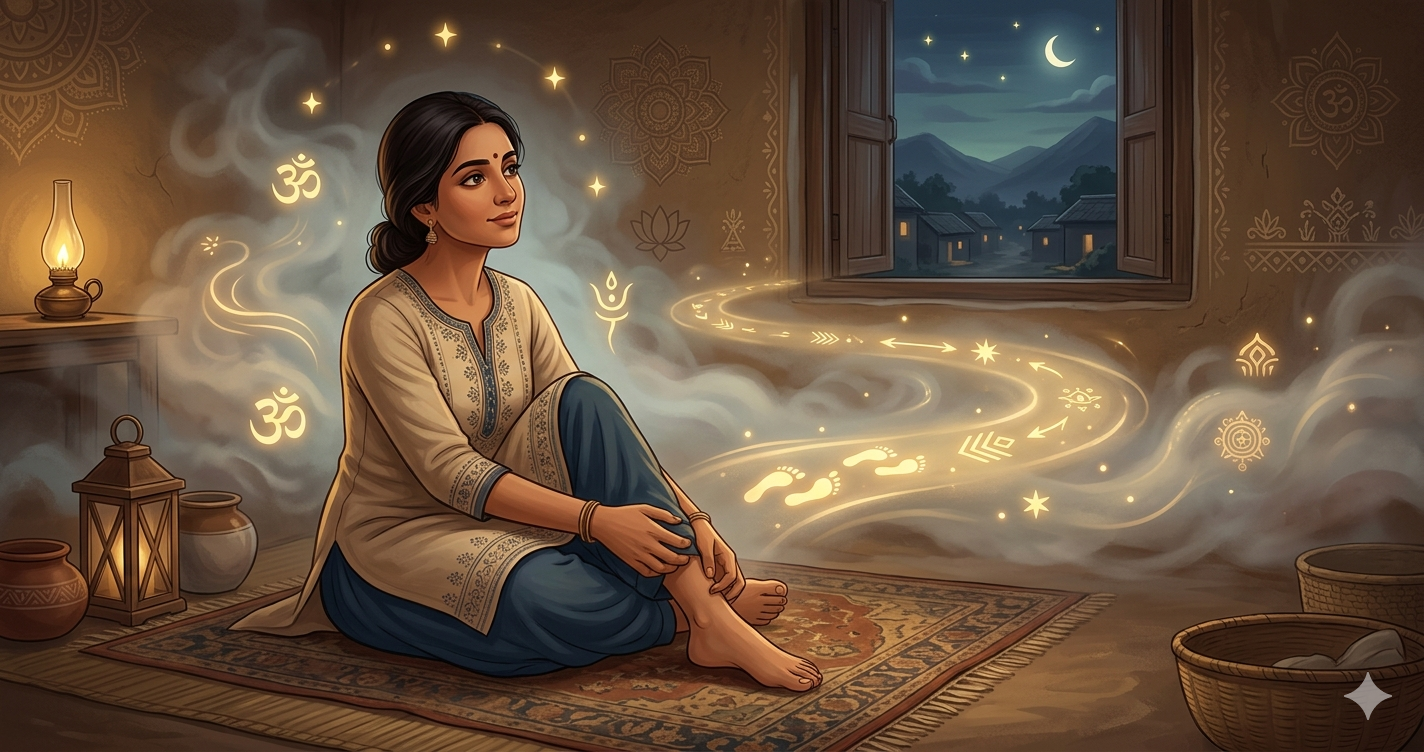
You are mid-stride — walking through a familiar hallway, crossing a street, or stepping onto a path you have walked a hundred times before — when a sudden, insistent itch rises from the sole of your left foot. You pause. You shift your weight. And for a moment, without knowing exactly why, something in you wonders whether this is more than just dry skin.
That instinct is older than you know.
If you have ever stopped to wonder about the why is my left foot itching spiritual meaning, you are asking a question that people have been pondering — in different languages, across different centuries, on every inhabited continent — long before the internet made it searchable.
From grandmothers in West Africa to elders in rural India, from Caribbean healers to Indigenous wisdom keepers in the Americas, the sudden itching of the left foot has rarely been dismissed as a simple physical inconvenience. It has been read, interpreted, and respected as a message.
The human body, in many of the world’s oldest spiritual traditions, is not a passive vessel. It is a living instrument of perception — capable of registering what the conscious mind has not yet processed and communicating what the ancestral lineage has long understood.
A sensation as specific as an itching left foot carries, within those traditions, a weight of meaning that modern life has largely trained us to ignore.
This article recovers that meaning. Moving through layers of history, indigenous traditional belief, ancestral communication, and the spiritual significance of obstacles and pauses, it traces why so many cultures took this particular itch seriously — and why you might find genuine value in doing the same.
The story begins, as most spiritual stories do, long before any of us arrived.
The Left Side Has Always Carried a Different Weight — A History of Asymmetric Symbolism
Long before anyone documented an itchy left foot superstition meaning in a manuscript or carved it into a temple wall, human civilizations had already built an elaborate architecture of meaning around the simple fact of bodily asymmetry.
Left and right were never neutral directions. They were moral, spiritual, and cosmic orientations — and the distinction shaped everything from how armies marched to how priests performed rituals.
In ancient Rome, the left side was the side of ill omen. The Latin word sinister, which today carries connotations of danger and malice, originally meant nothing more than “left.”
Roman augurs — the priests tasked with reading divine will through the behavior of birds — paid careful attention to which side of the sky a bird appeared on.
A bird crossing from the left signaled caution. A bad omen arrived from the left. The language itself encoded the warning.
Classical Greek thought reinforced this asymmetry through philosophical dualism. The Pythagoreans placed “left” explicitly in the column of negative, dark, and feminine principles — not as an insult, but as part of a cosmological balancing system in which every force had its receptive, cautionary counterpart. The left was the side that received, absorbed, and warned.
Early Christian tradition extended this symbolism further. The saved stood at God’s right hand; the condemned at the left.
This theological spatial coding embedded itself so deeply into Western culture that it survived centuries of institutional change and remains embedded in everyday language.
Eastern traditions offered a more nuanced view. In Hindu cosmology and Chinese philosophical systems, the left carried feminine, intuitive, and inward-facing energy — not inferior, but distinctly different in its orientation and function.
The feet, as the body’s point of contact with the earth, absorbed all of this accumulated symbolism. They are where intention becomes movement — and where, many traditions believed, the spirit world could most easily intervene.
Voices From the Roots — What Indigenous and Traditional Cultures Teach About an Itching Left Foot
Indigenous traditional beliefs about itching feet are not scattered superstitions preserved in amber. They are coherent systems of somatic knowledge — frameworks in which the body functions as a spiritual antenna, continuously receiving and translating information from the seen and unseen world.
Across vastly different geographies, cultures arrived at a remarkably consistent conclusion: when your left foot itches, something in your path requires attention.
West African and Diaspora Traditions: The Left Foot as a Threshold Messenger
In many West African spiritual traditions, including those carried forward through Yoruba practice and its diaspora expressions in Cuba, Brazil, and the Caribbean, the body is understood as a site where ancestral and divine energy makes direct contact with the living.
The left side, associated with the spirit world and receptive spiritual forces, is considered particularly sensitive to messages crossing the threshold between realms. An itching left foot, in this framework, is not a random irritation — it is a threshold signal.
It suggests that the traveler is approaching a crossing point: a decision, a boundary, or a space that requires spiritual preparation before entry. Elders in these traditions would advise pausing, offering a brief prayer or acknowledgment, before continuing forward.
South and Southeast Asian Perspectives: Omens Written in the Body
Across India, Sri Lanka, Thailand, and Indonesia, elaborate systems of bodily omens — known in Sanskrit-influenced traditions as Ang Sphuran or “body twitching” — have been documented for centuries in texts as well as oral tradition.
The left foot itching carries specific significance: for men, it is widely read as a traditional omen of unexpected obstacles ahead; for women, interpretations vary by region but commonly signal an approaching journey or a necessary change in direction.
These are not casual folk beliefs — they are integrated into daily decision-making, travel planning, and spiritual practice in communities where ancestral knowledge remains a living guide.
In Indigenous traditions of the Americas, including among various Plains Nations and Amazonian communities, bodily sensations during movement are read as communications from the land itself.
The earth, in these cosmologies, is a conscious relational presence. When your foot responds unusually to the ground beneath it, you are receiving information — not from your nervous system alone, but from the relationship between your body and the living world you are moving through.
When Ancestors Speak Through Sensation — Decoding the Spiritual Meaning of Left Foot Itching
Most people, when they think of ancestral communication, imagine dramatic encounters — a dream saturated with symbolic imagery, a vision at the edge of sleep, a voice arriving in a moment of crisis. But in many of the world’s oldest spiritual traditions, the ancestors are far more practical than that.
They speak through the ordinary. They speak through the body. And they speak, with particular frequency, through the feet — the part of the self that carries the living forward along paths the ancestors themselves once walked.
The spiritual meaning of left foot itching, within an ancestral communication framework, is among the most intimate and specific of these bodily messages.
It is understood not as a vague spiritual disturbance but as a direct intervention — a hand placed gently on the shoulder of someone walking too quickly toward ground that has not been spiritually cleared.
The ancestors, in this reading, are not alarming you. They are accompanying you. The itch is their way of saying: slow down, look closer, this step matters more than you realize.
What makes this framework emotionally resonant — and distinct from fear-based superstition — is its relational architecture. The ancestors who send these signals are not strangers.
They are your people. They have navigated the same categories of human experience: uncertain journeys, dangerous crossings, decisions made at the intersection of the known and the unknown.
Their warnings arrive not from a place of punishment but from a place of investment. They have a stake in where you are going.
This is spiritual kinship expressed somatically — love transmitted through sensation.
And what, specifically, are they cautioning you about? In tradition after tradition, the answer centers on the same theme: something unexpected is waiting in the path ahead. An obstacle. A boundary. A full stop disguised as a detour.
Traditional Omens of the Unexpected — Obstacles, Detours, and the Wisdom of the Unplanned Stop
There is a version of the obstacle that modern culture has not been kind to. It is treated as evidence of poor planning, bad luck, or personal failure — something to be overcome as quickly as possible and never spoken of again.
But the traditional omens of unexpected obstacles tell an entirely different story. In these frameworks, the obstacle is not an interruption of the journey. It is part of the journey’s design.
The itchy left foot superstition meaning, across European folk traditions, has long been tied to this exact interpretation. In British and Irish rural folklore, an itching left foot before a journey was a signal to reconsider departure — not necessarily to abandon the plan, but to pause, reassess, and proceed with heightened awareness.
The sensation was treated as environmental intelligence, a reading of conditions the traveler’s conscious mind had not yet registered.
Caribbean spiritual practice, shaped by the convergence of West African, Indigenous, and European traditions, developed similarly nuanced omen-reading systems.
In Haitian Vodou and Trinidad’s Orisha traditions, bodily omens — particularly those involving the feet — were consulted as seriously as any external sign.
A left foot itch before crossing into unfamiliar territory signaled that spiritual reconnaissance was needed before physical movement continued.
In East Asian traditions, particularly within Chinese folk belief, the body’s sudden and unexplained sensations were catalogued and interpreted through systems with centuries of accumulated observational wisdom.
An itching left foot was commonly associated with an impending complication in travel or plans — not catastrophe, but friction requiring navigation.
What unites these traditions is a shared reframing: the body already knows. The itch is not the problem — it is the warning that allows you to meet the problem with your eyes open.
Recognizing it is a form of ancestral literacy, a fluency in the language your lineage has always used to keep its people safe.
The only question that remains is what you do when the message arrives.
The Sacred Halt — Spiritual Boundaries, Pausing Your Path, and the Courage to Stand Still
Understanding what the left foot itch means is only half of the teaching. The other half — the half that transforms knowledge into practice — is understanding what it asks of you. And what it asks, across every tradition that has taken it seriously, is deceptively simple: stop.
Not forever. Not in fear. But with intention, with awareness, and with enough humility to acknowledge that your body may be registering something your ambition has chosen to overlook.
Spiritual boundaries and pausing your path are not passive experiences in any of the traditions that honor them. They are acts of courage.
In a culture that rewards relentless forward momentum, choosing to halt — choosing to stand still in the middle of a plan, a journey, or a decision already in motion — requires a particular kind of inner authority.
Indigenous traditions across North America have long held the deliberate pause as a sacred practice. Before crossing into new territory, many nations observed rituals of acknowledgment — stopping to address the land, the ancestors, and the spiritual conditions of the space ahead. The pause was not superstition. It was protocol. It was respect encoded into movement.
In Hindu contemplative practice, the concept of viveka — discernment — instructs the practitioner to pause at precisely the moments when action feels most urgent.
The Sufi tradition speaks similarly of waqfa, a sacred stop on the spiritual path where the traveler turns inward before proceeding outward.
African spiritual frameworks across multiple lineages describe the threshold — the space between where you are and where you are going — as requiring acknowledgment before it is crossed.
The practical application is accessible to anyone. When the left foot itches, pause. Breathe. Offer a moment of silent acknowledgment to your ancestors, to the ground beneath you, or simply to your own deeper knowing. Ask, without forcing an answer, whether the path ahead has been spiritually cleared.
That brief, deliberate stillness is not a delay. It is the most important step of the journey.
Reading the Full Body — How the Left Foot Fits Into a Broader Map of Spiritual Body Awareness
The left foot does not carry its symbolic weight in isolation. It belongs to a much larger system — one that human civilizations have been mapping, refining, and transmitting for thousands of years.
Somatic spirituality, the practice of reading the body as a living spiritual document, is among the oldest and most cross-culturally consistent frameworks in human history.
Nearly every major tradition that has engaged seriously with the unseen world has also engaged seriously with the body as its most immediate interface.
In Ayurvedic tradition, every region of the body corresponds to specific energetic and cosmic principles. In Traditional Chinese Medicine, the feet are understood as dense maps of the body’s entire organ system — points of entry and exit for the vital forces that govern health, direction, and wellbeing.
In many African traditional healing systems, the body is read symptom by symptom, sensation by sensation, as a diagnostic text written in real time by the interaction between the living person and their spiritual environment.
Within this broader map, the feet occupy a foundational position — literally and symbolically. They are the body’s point of contact with the earth, the mechanism through which intention becomes forward motion, and the first part of the self to enter unknown ground.
Of all the feet, the left foot moves first in many walking gaits, making it the body’s pioneer — the advance messenger that tests the spiritual temperature of new territory before the rest of the self commits to crossing it.
This is why the left foot’s sensations, and particularly the sudden insistence of an itch, carry such concentrated meaning across indigenous traditional beliefs about itching feet and the broader somatic spiritual tradition.
It is not merely a foot. It is a threshold instrument — and when it speaks, the oldest parts of human wisdom have always advised listening.
What remains is the question of how to carry that listening forward into daily life.
Honoring What Your Ancestors Left in Your Body — A Holistic Integration
The itching left foot was never just a superstition. It was a survival technology — a finely tuned system of embodied intelligence, passed down not through books or formal instruction, but through the body itself, encoded into the nervous system of every person who descended from people wise enough to pay attention.
Everything this article has traced leads back to a single, unifying insight: your body is not separate from your spiritual inheritance. It is the vessel through which that inheritance travels.
The historical weight assigned to the left side across Rome, Greece, and Eastern philosophy was not arbitrary cultural decoration — it was the accumulated observation of people who noticed patterns and took them seriously.
The indigenous traditional frameworks that read bodily sensation as spiritual communication were not primitive misunderstandings of biology — they were sophisticated epistemologies developed over generations of attentive living.
The ancestral communication framework, the omen of unexpected obstacles, the sacred practice of pausing — these are not relics. They are resources.
You do not need to belong to any specific tradition to claim this knowledge as your own. Every human lineage, without exception, developed some form of somatic spiritual awareness. The capacity to receive these signals is not tribal or regional.
It is human. What varies across cultures is the vocabulary — the specific meaning assigned to the left foot itch, the particular ritual offered in response, the name given to the ancestors consulted. But the underlying intelligence is universal.
So the next time your left foot itches mid-stride, you are not obligated to interpret it any particular way. You are simply invited to pause. To notice. To ask, with genuine curiosity, what the oldest part of you already knows.
Your ancestors walked difficult ground to bring you this far. The least you can offer them is a moment of stillness when they reach up through the earth to tap your foot.